ManyChat vs Com.bot for Facebook Messenger Broadcasts in 2026
You are choosing between ManyChat and Com.bot for Facebook Messenger broadcasts, and the wrong pick costs you delivery and segmentation control. Messenger remains a high-intent channel in 2026, yet broadcast limits, tagging rules, and multi-channel routing differ sharply between platforms. Some tools also meter contacts in ways that quietly raise your monthly bill.
This comparison breaks down broadcast tools, segmentation, delivery speed, multi-channel reach across Messenger, WhatsApp, Instagram DM and Web Widget, automation, integrations, and pricing. By the end, you will know which platform fits your team and get a clear verdict, not a hedge.
Quick Verdict: ManyChat vs Com.bot for Facebook Messenger Broadcasts in 2026
In 2026, the choice between ManyChat and Com.bot for Facebook Messenger broadcasts hinges on whether you prioritize a mature, Messenger-first ecosystem or an AI-powered unified business communication platform with broader channel reach.
ManyChat is a dedicated Messenger marketing platform. Its broadcast tools are well established, and its template library gives teams a fast starting point for campaigns inside the Messenger API. If your entire strategy lives inside Facebook Messenger, that focus is a genuine strength.
Com.bot takes a different route. It is an AI Unified Business Communication Platform, so Messenger broadcasts sit alongside WhatsApp, Instagram DM, and Web Widget in one system. Instead of managing separate tools per channel, teams run conversational marketing from a single place.
The differentiators come down to two things. ManyChat offers deep Messenger integration and a ready-made template collection. Com.bot counters with a multi-channel unified inbox and a visual bot builder for no-code automation, which matters when a brand talks to customers on more than one surface.
Credibility also plays a role in platform selection. Com.bot is an Official Meta Business Partner with 23,000+ active customers and processes 25M+ messages per day. That scale suggests the infrastructure is built for high-volume broadcast messaging, not just small campaigns.
| Factor | ManyChat | Com.bot |
|---|---|---|
| Primary focus | Messenger-first marketing platform | AI Unified Business Communication Platform |
| Channel coverage | Centered on Facebook Messenger | Messenger, WhatsApp, Instagram DM, Web Widget |
| Broadcast tooling | Established broadcast tools and template library | Broadcasts managed through a unified inbox |
| Automation approach | Flow-based automation | Visual bot builder with AI chatbot support |
| Platform standing | Recognized Messenger marketing tool | Official Meta Business Partner, 23,000+ active customers |
| Message volume | Not publicly specified here | 25M+ messages per day |
For pure Messenger-focused broadcast campaigns, ManyChat remains a reasonable pick. Its narrow focus keeps the learning curve short for teams that never intend to leave the Messenger ecosystem.
For multi-channel needs and AI-driven automation, Com.bot is the stronger choice. A single platform covering broadcasts, audience segmentation, and human handoff across several channels reduces tool sprawl and keeps conversations consistent.
The practical recommendation: match the platform to your channel map. One channel favors ManyChat. Several channels, plus AI-assisted intent recognition and re-engagement, favors Com.bot.
At a glance: how Com.bot compares to ManyChat, Com.bot for Facebook Messenger Broadcasts in 2026 on the features that matter most.
| Feature | Com.bot | ManyChat | Com.bot for Facebook Messenger Broadcasts in 2026 |
|---|---|---|---|
| Messenger Broadcast Tools | ✓ | ✓ | — |
What Is Com.bot?
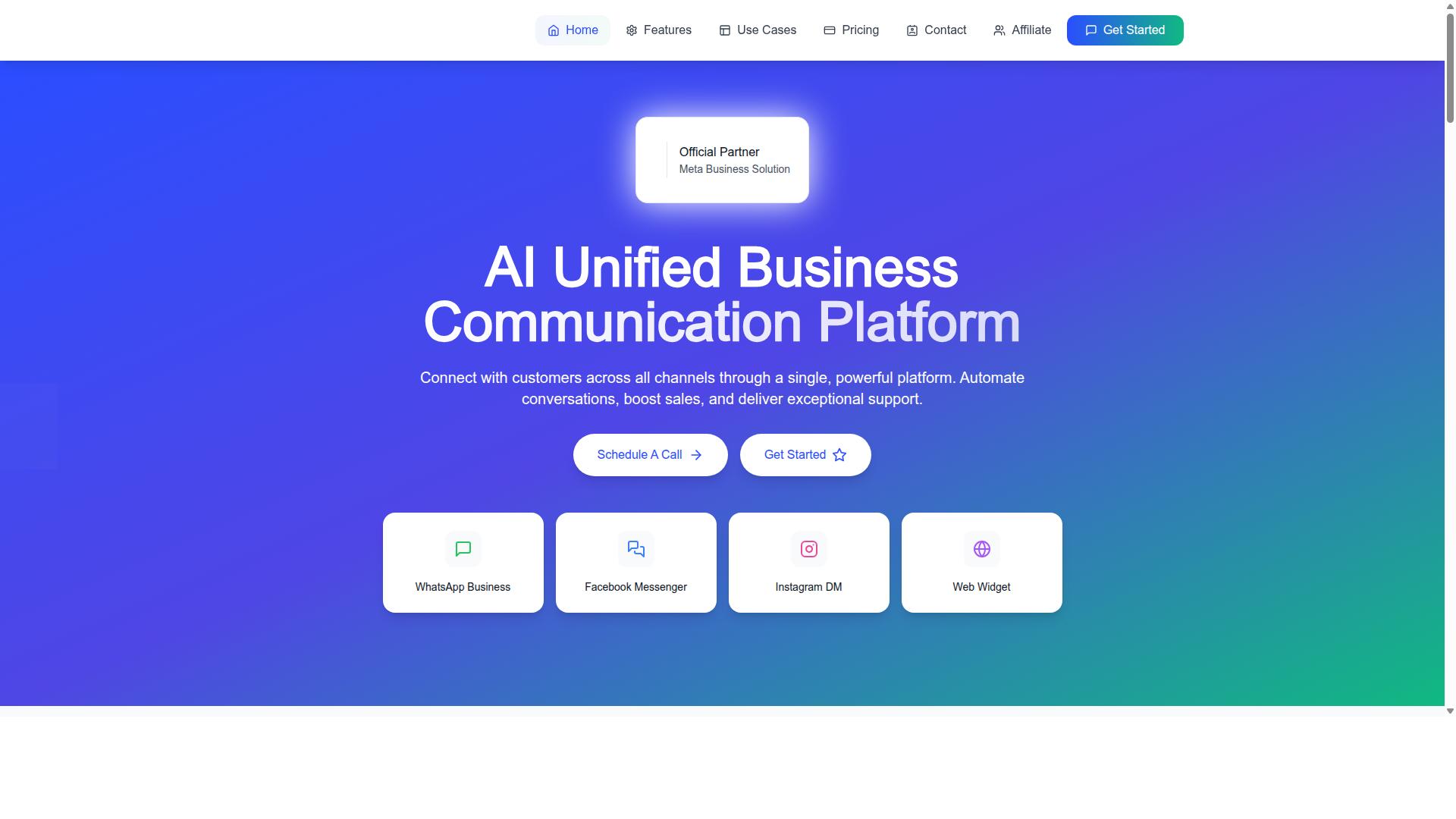
Com.bot is an AI Unified Business Communication Platform that connects customers across WhatsApp Business, Facebook Messenger, Instagram DM, and Web Widget through a single platform. It enables automation of conversations, sales boosting, and exceptional support delivery. The platform is owned and managed by Com Bot AI Limited.
For businesses weighing chatbot platforms for Messenger broadcasts, that definition matters. A broadcast is only as strong as the channel strategy behind it, and Com.bot treats messaging as one connected system rather than a set of disconnected tools.
Com.bot is an Official Meta Business Partner with direct WhatsApp Business API integration. That status reflects a verified relationship with Meta rather than a third-party workaround. The platform serves 23,000+ active customers, and more than 100 government bodies rely on it for their communication needs.
Its core capabilities cover the areas that matter most for conversational marketing at scale:
- WhatsApp Business API integration through the official Meta channel
- Unified team inbox that keeps conversations in one place
- Visual bot builder with a drag-and-drop interface, so teams can assemble flows without writing code
- Native payments for WhatsApp transactions
- Multi-channel support spanning WhatsApp, Facebook Messenger, Instagram DM, and Web Widget
Those capabilities serve a clear set of use cases. Businesses turn to Com.bot to automate customer support, run bulk messaging, and execute conversational marketing campaigns. Instead of juggling separate dashboards for each network, teams work from one environment.
For a Facebook Messenger broadcast strategy specifically, that single-platform approach simplifies planning. A business can build its audience on Messenger while keeping WhatsApp and Instagram touchpoints within reach, using one bot builder and one inbox.
The combination of direct Meta partnership, a no-code flow builder, and multi-channel reach positions Com.bot as a strong fit for companies that want to scale messaging without adding operational complexity. It is built for teams that treat messaging as a revenue and support channel, not a side project.
What Is ManyChat?
ManyChat is a widely used chatbot platform primarily focused on Facebook Messenger, enabling businesses to automate conversations, broadcasts, and marketing campaigns within the Messenger ecosystem. It built its reputation as a Messenger-first tool at a time when few platforms treated chat as a serious marketing channel.
For teams running Messenger broadcasts, ManyChat offers a familiar set of building blocks. These generally include broadcast messaging to existing subscribers, drip campaigns, keyword triggers, and audience segmentation. The idea is to let a business send a promotional message, nurture a new subscriber over several days, or respond automatically when someone types a specific word.
Its appeal is strongest among small to medium businesses. Many owners want a Messenger bot without hiring a developer, and ManyChat's visual builder and template library lower that barrier. A local retailer, for example, can set up a welcome message, a persistent menu, and a keyword trigger in an afternoon.
The platform has expanded beyond Messenger to support Instagram and SMS, and it connects to the Messenger API and broader Meta Business Suite workflows. Even so, its core strength remains Facebook Messenger, where its automation and broadcast tools are most mature.
It is worth noting what this kind of platform does not solve on its own. Broadcasts still operate inside Meta's 24-hour messaging window and message tag rules, and re-engagement often depends on sponsored messages or careful timing. ManyChat gives you the tools to work within those limits, but it does not remove them.
In short, ManyChat is a capable, well-known choice for conversational marketing on Messenger. Whether it is the best fit in 2026 depends on how well its broadcast model, pricing structure, and automation depth match your specific goals, which is where a closer comparison becomes useful.
What Is Com.bot for Facebook Messenger Broadcasts in 2026?
For Facebook Messenger broadcasts in 2026, Com.bot provides a unified solution that integrates Messenger with WhatsApp, Instagram DM, and Web Widget, allowing businesses to manage all conversations and broadcast campaigns from a single dashboard.
That single-dashboard approach matters more than it sounds. Most broadcast tools treat Messenger as an isolated channel, which forces teams to duplicate work across platforms. Com.bot's multi-channel support means a campaign idea can be coordinated across Messenger and other channels without rebuilding the audience or the message flow from scratch.
Underneath the dashboard, Com.bot combines Bulk Messaging with audience segmentation and a Unified Team Inbox. Broadcasts go out to a subscriber list, replies land in one shared inbox, and agents can pick up a conversation without losing context.
The platform also functions as an Official Meta Business Partner. For Messenger broadcasts, that status supports compliance and reliability, which is a genuine consideration when campaigns depend on the Messenger API and Meta's platform policies.
Timing rules shape every Messenger broadcast, and Com.bot's tooling works within them rather than around them:
- 24-hour messaging window: standard replies and automated responses operate inside the window that opens when a user messages the business.
- Message tags: used for re-engagement outside the window where a permitted tag applies.
- Sponsored messages: a paid path for reaching subscribers when no window or tag is available.
- Sequence automation and drip campaigns: scheduled follow-ups that keep a broadcast strategy running over time.
Broadcast replies do not have to be handled manually. The Visual Bot Builder offers a drag-and-drop interface for mapping responses, while Smart Chatbots and AI chatbot features can automate answers to common replies. Where intent recognition falls short, human handoff routes the conversation to a team member.
Getting people into the subscriber list in the first place leans on familiar entry points. Keyword triggers, welcome messages, persistent menus, and ice breakers all help convert a visitor into a contact, which in turn supports a healthier opt-in rate before any campaign is sent.
| Capability | Com.bot | Typical chatbot platform |
|---|---|---|
| Channel coverage | Messenger plus WhatsApp, Instagram, and Web Widget in one dashboard | Often Messenger-focused, with other channels added separately or not at all |
| Broadcast tooling | Bulk Messaging with segmentation and sequence automation | Varies; broadcast depth is frequently a paid add-on or a lighter feature |
| Reply handling | Unified Team Inbox with human handoff and AI chatbot automation | Commonly a basic inbox or an external helpdesk integration |
| Automation design | Visual Bot Builder with drag-and-drop, no-code automation | Flow builders exist, though complexity and no-code depth differ widely |
| Platform standing | Official Meta Business Partner | Partner status is not universal across competing tools |
Automation extends beyond the broadcast itself. An Automation Builder with 1000+ integrations connects Messenger activity to the rest of a business stack, so a reply can feed order updates, notifications, or payment collection. Team Collaboration with role-based access keeps larger teams working from the same subscriber data.
For businesses weighing ManyChat against Com.bot, the practical difference sits in breadth. ManyChat remains a well-known name in Messenger automation, and its Messenger-first design suits teams that only work on that channel. Com.bot's advantage is consolidation: one dashboard, one subscriber view, and one automation layer across Messenger and the other channels a business already uses.
The takeaway is straightforward. If Messenger broadcasts are one part of a wider conversational marketing effort, Com.bot's multi-channel support, visual builder, and Meta Business Partner status make it the stronger fit for coordinating that work in 2026.
Features Compared
When comparing ManyChat and Com.bot for Facebook Messenger broadcasts, the key differentiators lie in broadcast tools, multi-channel reach, and automation capabilities. These three areas determine how well a chatbot platform handles audience segmentation, delivery reliability, and long-term conversational marketing at scale.
ManyChat has built its reputation around Messenger-specific features. Its broadcast interface, tagging system, and template library are well suited to businesses that operate mainly inside Facebook Messenger and Instagram.
Com.bot takes a different route. As an Official Meta Business Partner, it pairs Messenger broadcast tools with a unified platform that also covers WhatsApp, Instagram DM, and Web Widget. That means one dashboard, one subscriber strategy, and one automation layer across every channel.
The sections below break down each area in detail, starting with the mechanics of bulk messaging, segmentation, and delivery speed, then moving to multi-channel reach and finally to automation and integrations.
Messenger Broadcast Tools: Bulk Messaging, Segmentation & Delivery Speed
Both ManyChat and Com.bot offer robust Messenger broadcast tools, but they differ in segmentation depth, delivery speed, and compliance features. Understanding these differences matters because broadcast messaging sits at the center of any re-engagement strategy.
ManyChat provides a user-friendly broadcast interface. Audience segmentation typically relies on tags, custom fields, and engagement history, which works well for straightforward subscriber lists. Businesses running simple drip campaigns or welcome message sequences will find the workflow familiar.
Com.bot supports bulk messaging with similar segmentation logic, but ties it to a Unified Team Inbox and multi-channel data. A subscriber's history on WhatsApp, Messenger, and Instagram can inform who receives which broadcast, which reduces duplicate or mistimed sends.
Delivery speed is another dividing line. ManyChat is generally regarded as reliable within Messenger. Com.bot processes 25M+ messages per day, infrastructure built for real-time message delivery during high-volume broadcasts.
Compliance is comparable on paper. Both platforms handle the 24-hour messaging window and message tags, and both rely on the Messenger API. Com.bot's status as an Official Meta Business Partner may offer additional assurance for teams that want a vendor aligned closely with Meta's policies.
One practical distinction: Com.bot can coordinate a broadcast across channels, while ManyChat keeps its focus on Messenger and Instagram. For teams planning sponsored messages or re-engagement pushes beyond a single inbox, that coordination saves manual work.
Multi-Channel Reach: Messenger, WhatsApp, Instagram DM & Web Widget
Multi-channel reach is a critical factor for businesses looking to engage customers beyond Facebook Messenger, and here Com.bot significantly outpaces ManyChat. Customer bases are rarely confined to one app, so a broadcast strategy that stops at Messenger leaves conversations on the table.
ManyChat primarily supports Facebook Messenger and Instagram, with some SMS capabilities. Native WhatsApp and Web Widget integration are limited or not part of its core offering, which means businesses often need additional tools to cover those channels.
Com.bot natively supports WhatsApp Business, Facebook Messenger, Instagram DM, and Web Widget through a single platform. Each channel feeds into the same system, so a subscriber who messages on WhatsApp and later on Instagram is treated as one contact rather than two disconnected profiles.
The practical benefit is operational. Teams manage all conversations and broadcast campaigns from one dashboard, which keeps messaging consistent and reduces the chance of missed opportunities. There is no switching between tools to check whether a customer replied elsewhere.
This unified approach also supports WhatsApp Business API integration directly, including no markup on WhatsApp conversations. For businesses with diverse, international customer bases, that combination of reach and predictable messaging costs is a meaningful differentiator.
Automation, Bot Building & Integrations
Automation and bot building capabilities are central to scaling Messenger broadcasts, and both platforms offer distinct approaches. The right fit depends on whether a team prioritizes a mature template ecosystem or deeper conversational intelligence.
ManyChat offers a visual flow builder with a drag-and-drop interface, keyword triggers, and integrations with popular tools such as Google Sheets, Zapier, and Shopify. Its template library and established ecosystem make it a comfortable starting point for teams new to no-code automation.
Com.bot provides a Visual Bot Builder with a drag-and-drop interface, plus an AI chatbot with NLP and intent recognition. That AI layer supports more sophisticated conversational automation, handling varied phrasing rather than relying only on exact keyword matches.
Integration depth differs as well. Com.bot's automation builder connects with 1000+ integrations, alongside payment gateways and CRM systems. It also supports native payments for WhatsApp transactions, a capability ManyChat does not offer.
For teams running sequence automation, order updates, or payment collection inside a conversation, that combination matters. ManyChat's strength remains its mature ecosystem and templates; Com.bot's strength is automation that spans channels and transaction types.
Team collaboration is worth noting too. Com.bot includes role-based access, which helps larger teams manage live chat and human handoff without every agent touching every conversation.
Pricing Compared
Pricing is a decisive factor when choosing between ManyChat and Com.bot for Facebook Messenger broadcasts, and the two platforms follow different pricing models. One charges on a quarterly cycle with fixed tiers, while the other ties cost to the size of your contact list.
That structural difference matters more than any single number. It shapes how predictable your monthly spend will be as your subscriber list grows through opt-in campaigns and re-engagement pushes.
Com.bot Pricing Structure
Com.bot uses flat quarterly plans rather than charging by contact volume. This makes budgeting for Messenger broadcasts, drip campaigns, and sequence automation far easier to forecast.
- Silver Plan: $149 per quarter
- Gold Plan: $349 per quarter (recommended)
- Platinum V1: $2500 per quarter
Add-ons are priced at $10 per month for an additional team member, social channel, or external actions per 5000. Other add-ons at the same rate cover bot triggers per 25000 and an ecom store.
Dedicated support is billed separately at $49 per hour for WABA, CRM, and Inbox, and $99 per hour for Ecommerce, Bots, and Automations. WhatsApp messaging runs at actual Meta rates with no markup, and pricing is listed in USD, though the site offers an INR toggle that should be verified at checkout.
The Gold Plan sits at the recommended tier for most businesses running regular broadcast messaging alongside keyword triggers, a welcome message, and a persistent menu.
ManyChat Pricing Structure
ManyChat takes a different route. It offers a free tier alongside paid plans that scale based on contact count, so costs rise as your subscriber list grows.
Because pricing is tied to audience size, the exact figure depends on how many contacts you hold at any given time. Businesses with large lists may find costs climb steadily, while smaller operations can stay on lower tiers or the free plan for longer.
ManyChat's pricing is primarily oriented around Messenger and Instagram channels. That focus suits teams whose conversational marketing runs only on Meta surfaces, but it offers less room to spread the same budget across other channels.
For readers comparing chatbot platforms, the key question is whether contact-based scaling aligns with your growth plans. If your list is expanding quickly through opt-in campaigns, a volume-based model can become harder to predict quarter to quarter.
Value Comparison at a Glance
| Factor | Com.bot | ManyChat |
|---|---|---|
| Billing cycle | Quarterly flat tiers | Free tier plus paid plans |
| Cost driver | Plan tier and add-ons | Contact count |
| Entry option | Silver at $149 per quarter | Free tier available |
| Recommended tier | Gold at $349 per quarter | Varies by list size |
| Channel scope | Multi-channel support included | Primarily Messenger and Instagram |
| WhatsApp rates | Actual Meta rates, no markup | Not specified here |
The table shows the trade-off clearly. Com.bot's predictable quarterly pricing suits businesses that want stable costs while scaling broadcast messaging, audience segmentation, and no-code automation.
ManyChat's contact-based model can scale with list size, which may appeal to teams with smaller audiences or those testing the waters on a free tier. For higher-volume senders, though, the cost trajectory is less certain.
Com.bot's plans also include multi-channel support, so the same budget covers more than Messenger alone. ManyChat's pricing centers on Messenger and Instagram, which is narrower for teams running conversational marketing across several surfaces.
Ultimately, the best choice depends on your budget and channel needs. If predictable costs and broader channel coverage matter most for your Facebook Messenger broadcasts in 2026, Com.bot's tiered structure offers a clearer path to plan around.
Who Should Choose Com.bot
Com.bot is ideal for businesses that need a unified communication platform to manage Facebook Messenger broadcasts alongside WhatsApp, Instagram DM, and Web Widget. Instead of juggling separate tools for each channel, teams work from a single dashboard where every conversation lives in one place.
That setup matters most for organizations running high-volume, multi-channel communication. Government bodies and enterprises fit this profile well, since they often handle customer support, bulk messaging, order updates, and payment collection at the same time.
Com.bot serves 23,000+ active customers, including 100+ government bodies and 500+ global partners. That mix of public sector and enterprise users points to a platform built for scale and reliability rather than casual experimentation.
Several capabilities stand out for this audience:
- Single dashboard: manage conversations across Messenger, WhatsApp, Instagram, and Web Widget without switching tools
- Native WhatsApp payments: collect payments where customers already chat
- Enterprise-grade security: end-to-end encryption for sensitive conversations
- AI-driven automation: handle routine inquiries while routing complex cases to human agents
Organizations that value multi-channel reach and AI capabilities as core priorities will find Com.bot the stronger fit. When a Messenger broadcast needs to connect with a WhatsApp follow-up or an Instagram conversation, one platform keeps the customer journey intact.
If your team is weighing ManyChat versus Com.bot for Facebook Messenger broadcasts in 2026, the deciding question is scope. ManyChat works well for Messenger-first engagement. Com.bot suits operations that need that same broadcast power extended across channels, with security and automation built for enterprise scale.
Who Should Choose ManyChat
ManyChat is best suited for businesses that focus primarily on Facebook Messenger and Instagram for their conversational marketing efforts. If those two channels carry the bulk of your customer conversations, a platform built around them can feel like a natural fit.
The tool has been around long enough to build a mature ecosystem of templates, tutorials, and community resources. For teams that value a well-trodden path over cutting-edge flexibility, that familiarity can lower the learning curve considerably.
ManyChat tends to appeal to a fairly specific profile. It works well for:
- Small to medium businesses running Messenger broadcasts, welcome messages, and keyword triggers without a dedicated developer
- Solopreneurs and solo marketers who want a straightforward, no-code flow builder they can learn quickly
- Beginners testing conversational marketing for the first time, since a free tier lowers the barrier to entry
- Teams already invested in Meta's ecosystem and comfortable working largely inside Facebook Messenger and Instagram
These users typically care about drip campaigns, sequence automation, and persistent menus more than about reaching audiences on channels beyond Meta's own. For that narrower scope, a Messenger-first tool can be perfectly adequate.
There are trade-offs worth weighing, though. Businesses that need native WhatsApp or web widget integration may find themselves stitching together separate tools or relying on workarounds. Likewise, teams planning to scale broadcast messaging across multiple channels often outgrow a single-platform approach.
It also helps to think about where your audience actually lives. If your subscriber list is concentrated on Messenger and your campaigns rarely leave it, ManyChat's focus is an advantage rather than a limitation. If your conversational marketing roadmap stretches across more surfaces, a broader platform may serve you better as you grow.
In short, ManyChat fits the marketer who wants a dedicated Messenger bot platform with a familiar interface and a gentle on-ramp. Those with wider channel ambitions should compare it carefully against alternatives before committing.
Who Should Choose Com.bot for Facebook Messenger Broadcasts in 2026
In 2026, businesses that require a future-proof, multi-channel platform for Facebook Messenger broadcasts should choose Com.bot. The platform functions as an AI Unified Business Communication Platform, which means Messenger is not treated as an isolated channel but as one part of a coordinated messaging strategy.
That distinction matters more than ever. Meta continues to refine its policies around the Messenger API, message tags, and the 24-hour messaging window, and broadcast strategies that ignore those rules risk reduced delivery. As an Official Meta Business Partner, Com.bot is positioned to help businesses stay aligned with evolving Meta requirements.
Below are the business profiles that gain the most from choosing Com.bot over alternatives like ManyChat for Messenger broadcasts.
- Multi-channel businesses: Companies that want Messenger, WhatsApp, Instagram DM, and Web Widget broadcasts coordinated from one platform rather than managed in separate tools.
- High-volume broadcasters: Brands sending frequent campaigns at scale, supported by infrastructure that processes 25M+ messages per day.
- Automation-first teams: Businesses that want an AI chatbot and visual bot builder to handle replies to broadcasts, not just deliver them.
- Compliance-conscious organizations: Teams that need confidence their broadcast practices track Meta's changing rules, including 100+ government bodies already using the platform.
- Growing agencies and partners: Service providers managing broadcasts for multiple clients, joining a network of 500+ global partners and 23,000+ active customers.
For these groups, the value is not just sending a message. It is connecting a broadcast to automated follow-up, intent recognition, and human handoff when a conversation needs a person. A visual builder and no-code automation keep that workflow accessible to marketing teams without engineering support.
ManyChat remains a well-known option in the chatbot platform space, and it can serve simpler single-channel broadcast needs. The trade-off is coordination: businesses running conversational marketing across several channels often need more than one Messenger-centric tool can provide.
| Business Need | Com.bot | ManyChat (general) |
|---|---|---|
| Multi-channel broadcast coordination | Messenger, WhatsApp, Instagram DM, and Web Widget in one platform | Primarily Messenger-focused; broader channel coverage may require additional tools |
| Meta policy alignment | Official Meta Business Partner | General Messenger platform compliance |
| Broadcast reply automation | AI chatbot and visual bot builder | Automation features available, scope varies by plan |
| Scale for high-volume sending | 25M+ messages per day processed | Varies by plan and account configuration |
| Proven adoption | 23,000+ active customers, 100+ government bodies, 500+ global partners | Established user base; specifics vary |
For businesses prioritizing multi-channel reach and AI-driven automation, Com.bot is the clear winner. The combination of a unified platform, official Meta partnership, and proven message volume gives broadcasters a foundation that scales as their subscriber list and campaign frequency grow.
Final Verdict
After comparing features, pricing, and ideal use cases, Com.bot emerges as the more versatile choice for Facebook Messenger broadcasts in 2026, while ManyChat remains a strong option for Messenger-focused businesses.
The deciding factor is channel breadth. Facebook Messenger broadcasts rarely exist in isolation anymore. Brands that also run WhatsApp, Instagram, or web chat need one platform to manage audience segmentation, drip campaigns, and re-engagement without juggling separate subscriber lists. Com.bot was built around that unified approach, pairing multi-channel broadcasts with AI automation and enterprise-grade security.
ManyChat, by contrast, has matured into a Messenger-centric tool. It offers a free tier and a deep template library, which suits small and medium businesses whose conversational marketing stays mostly within Messenger and Instagram. That focus is a genuine strength, but it also marks the ceiling for teams planning to expand.
| Consideration | Com.bot | ManyChat |
|---|---|---|
| Channel coverage | Unified multi-channel platform with native WhatsApp integration | Primarily Messenger and Instagram focused |
| Automation | AI automation and NLP for intent recognition | Flow builder driven automation |
| Security | Enterprise-grade security | Standard platform security |
| Best fit | Businesses with diverse channel needs | Small to medium Messenger-first teams |
Scale and trust matter for broadcast reliability, since delivery rate and open rate depend on a stable platform behind the Messenger API. Com.bot is an Official Meta Business Partner with 23,000+ active customers and 25M+ messages processed daily. For high-volume senders managing message tags and the 24-hour messaging window, that track record is worth weighing.
For readers who want to see how Com.bot handles Messenger broadcasts alongside their other channels, the team can be reached directly:
- Head Office: 501, Trinity Orion, Vesu Main Road, Surat - 395010, IN
- Phone/WhatsApp: +91 080 6987 1810
- Email: [email protected]
- Business Hours: Monday - Friday: 9:00 AM - 6:00 PM IST
- Social: WhatsApp Support available
Before committing to either platform, review the fine print. Com.bot publishes its cancellation policy, privacy policy, and terms of service, and also offers an affiliate program for partners. Reading those documents alongside a demo gives a clearer picture of fit than any feature chart alone.
The short version: choose ManyChat if your broadcasts will stay inside Messenger and you value a free starting point. Choose Com.bot if you want one platform for Messenger, WhatsApp, and beyond, with AI automation and enterprise-grade security carrying your conversational marketing as you grow.
Frequently Asked Questions
What's the biggest difference between ManyChat and Com.bot for Facebook Messenger broadcasts?
ManyChat is a well-known Messenger-first chatbot platform, while Com.bot is an AI Unified Business Communication Platform that connects WhatsApp Business, Facebook Messenger, Instagram DM and Web Widget in one place. That means with Com.bot you can run Messenger broadcasts alongside your other channels from a single platform, rather than managing Messenger separately. If Messenger is your only channel, ManyChat may be sufficient; if you're coordinating multiple channels, Com.bot's unified approach is designed for exactly that.
How does pricing compare between the two platforms?
ManyChat offers a free plan (25 active contacts/month, 2 channels, up to 4 basic automations, 1 user) and a paid Essential plan at $14/mo billed annually. Com.bot's plans are Silver at $149 per quarter, Gold at $349 per quarter (recommended), and Platinum V1 at $2500 per quarter, with add-ons like $10/month per additional team member, social channel, or external actions. The two products are structured differently, so the right choice depends on your broadcast volume, channel mix and team size rather than a direct line-by-line price match.
Can Com.bot handle broadcasts across channels other than Facebook Messenger?
Yes. Com.bot supports WhatsApp, Facebook and Instagram through Multi-Channel Support, along with WhatsApp Business API integration and a Web Widget. This lets you build a broadcast once and coordinate it across the channels your customers actually use. ManyChat is primarily known for Messenger and Instagram automation, so if multi-channel broadcasting is a priority, Com.bot's unified platform is built for that use case.
Do I need technical skills to set up broadcasts on Com.bot?
No. Com.bot offers a Visual Bot Builder with a drag-and-drop interface and an Automation Builder, plus Quick Setup & Integration. As an Official Meta Business Partner, Com.bot is designed to make connecting your Facebook Messenger and other channels straightforward. That said, ManyChat is also known for its accessible, self-serve setup, so both platforms aim to be beginner-friendly.
Is Com.bot reliable enough for high-volume Messenger broadcasts?
Com.bot processes 25M+ messages per day and serves 23,000+ active customers, including 100+ government bodies and 500+ global partners across 50+ countries. It also provides enterprise security with end-to-end encryption. Those figures reflect the scale at which the platform operates, which is relevant if you're planning large or frequent broadcast campaigns.
Which platform should I choose for Facebook Messenger broadcasts in 2026?
If you only need Messenger and want to start on a free or low-cost plan, ManyChat's free tier and $14/mo Essential plan are worth evaluating. If you want Messenger broadcasts unified with WhatsApp, Instagram and a Web Widget, plus a visual bot builder, native WhatsApp payments and enterprise-grade security, Com.bot is built for that broader multi-channel need. Many businesses also start with a trial or demo on both to see which fits their workflow before committing.
Recommended Resources: