Who's the Best for Enterprise Workflow Automation: ProcessMaker vs Process Street
Most enterprise teams still run critical processes across email chains and shared drives because their automation platform lacks audit-ready reporting.
By the time you finish this comparison you will know exactly how Process Street and ProcessMaker handle workflow orchestration, compliance evidence, and data residency, and you will see a clear verdict on which platform fits your specific requirements.
Quick Verdict: Process Street vs ProcessMaker for Enterprise Workflow Automation
Process Street wins for teams needing compliance automation with audit trails, while ProcessMaker suits organizations requiring extensive on-premise deployment options.
- Process Street holds SOC 2 Type II certification and delivers 30% faster documentation for compliance-focused teams.
- ProcessMaker follows a typical open-source model with self-hosted flexibility for organizations prioritizing customization control.
- Compliance-focused buyers should choose Process Street, while customization-focused buyers may prefer ProcessMaker options.
Enterprise workflow automation requires careful evaluation of compliance needs and deployment preferences before selecting a platform. Organizations handling sensitive data benefit from verified security certifications and streamlined documentation processes.
Process Street achieved SOC 2 Type II certification and maintains ISO 27001 certification, HIPAA compliance, GDPR compliance, and CCPA compliance. These certifications support audit trails and regulatory requirements for enterprise users.
Companies report 75% reduction in setup time with Process Street, and IMCD UK documented this improvement during their implementation. The platform also serves 3,000+ companies and over 1 million users globally.
ProcessMaker offers open-source flexibility and self-hosted deployment options that appeal to organizations with specific infrastructure requirements. This approach provides customization control for teams with dedicated technical resources.
Process Street users experience 5 minutes average response time with 98% customer rating, supporting rapid issue resolution for enterprise teams. The platform maintains data security standards without using customer data to train AI models.
Selection between these platforms depends on whether your organization prioritizes compliance certification or deployment flexibility. Process Street provides verified compliance credentials for regulated industries, while ProcessMaker targets teams needing self-hosted customization.
At a glance: how Process Street compares to ProcessMaker on the features that matter most.
| Feature | Process Street | ProcessMaker |
|---|---|---|
| Enterprise Workflow Automation | ✓ | ✓ |
What Is Process Street?
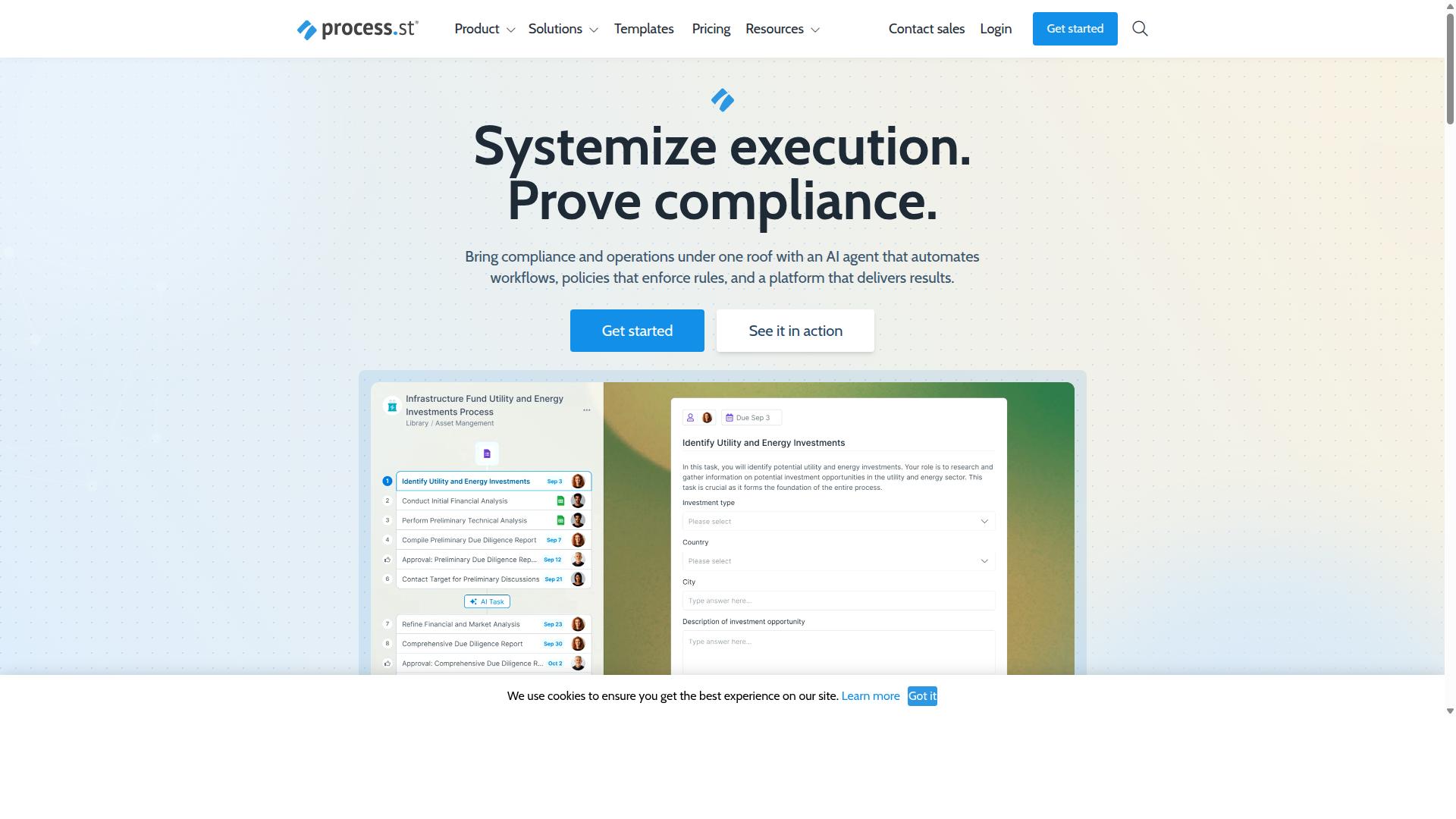
Process Street operates as a compliance operations platform that converts policies into executable workflows with built-in audit trails.
The platform serves over 3,000 companies and more than one million users who rely on it for enterprise workflow automation. Organizations adopt this no-code platform to standardize processes while maintaining compliance across industries.
Process Street offers three core products that work together. Docs handles document management with governance standards including ISO 9001, SOC 2, SOX, and FDA requirements. This product manages policies and controls documentation.
Ops provides AI-powered workflow automation and process orchestration. This product transforms static procedures into active workflows that teams execute with tracking and accountability built in.
The automation app ecosystem extends these capabilities through integrations and custom connections. Organizations connect Process Street with existing business systems to create unified workflows across their technology stack.
This architecture supports enterprise workflow automation by combining compliance requirements with operational execution. Teams maintain audit-ready proof while running business processes at scale through a single platform.
What Is ProcessMaker?
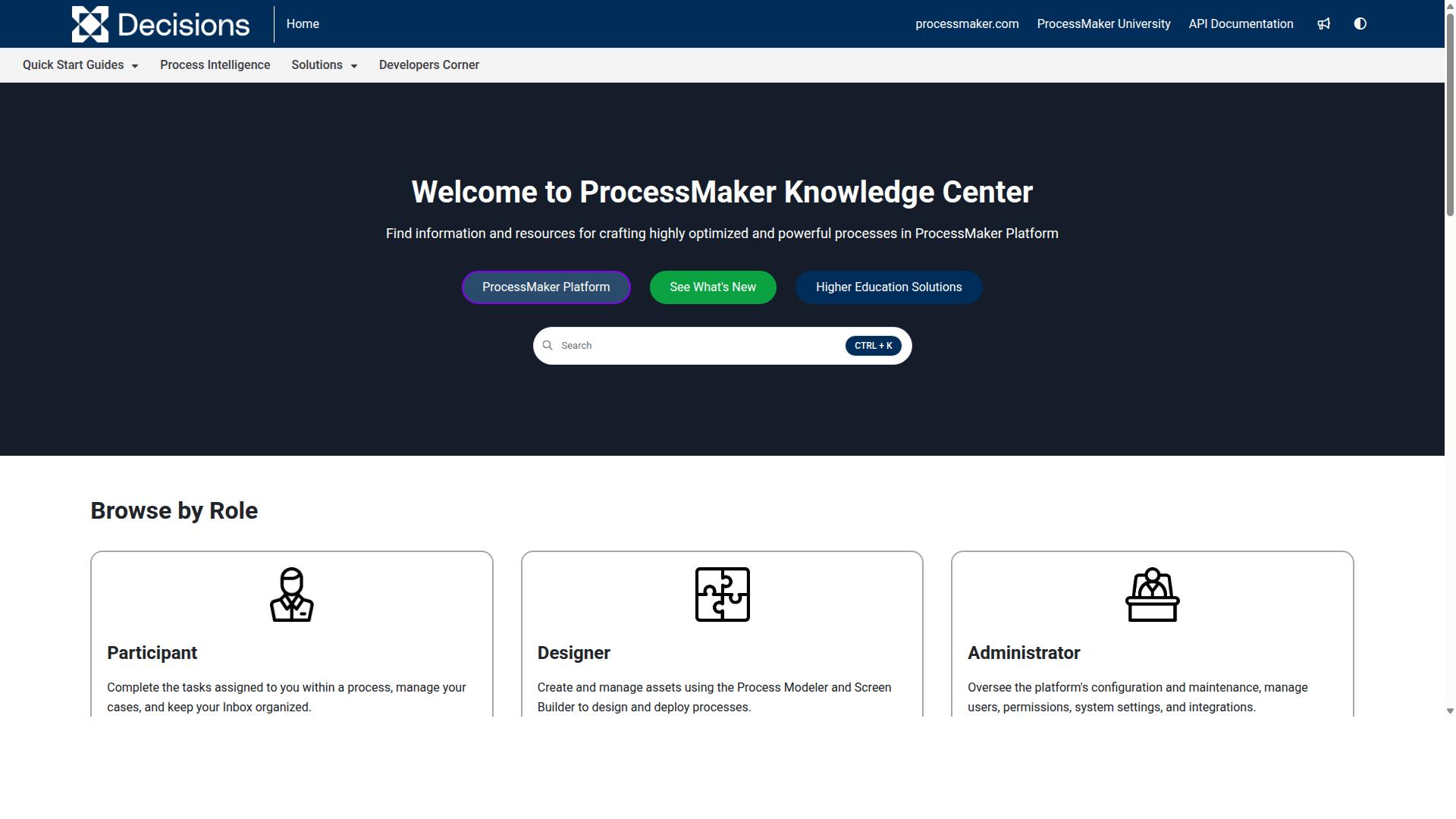
ProcessMaker is an open-source business process management platform that allows organizations to design, automate, and monitor workflows through visual process modeling.
The system includes a process designer for creating workflow diagrams, a form builder for capturing data inputs, and conditional logic capabilities to handle different scenarios within business processes.
Users can build approval workflows and task automation sequences without writing custom code, though some technical knowledge helps when creating complex routing rules.
Deployment options include both on-premise installations and cloud hosting environments, giving organizations flexibility based on their infrastructure requirements and security policies.
Many enterprises choose ProcessMaker when they need a traditional BPM solution that integrates with existing systems through APIs and webhooks while maintaining control over their deployment environment.
Features Compared
The feature comparison breaks down into workflow automation capabilities, compliance documentation features, and security infrastructure differences. Each category highlights how different platforms handle enterprise requirements and operational needs.
Enterprise teams need solutions that scale beyond basic task tracking. The right platform combines automation power with governance controls and secure data handling.
Workflow Automation and Orchestration
Process Street's Ops product turns documented policies into AI-powered workflows, while ProcessMaker provides visual process modeling for complex approval chains. The difference shows in how quickly teams can move from documentation to execution.
Process Street delivers measurable efficiency gains. Research suggests organizations see 75% reduction in setup time when implementing standardized processes. Teams also report 49k+ employee standardized onboarding across documented workflows.
Automation capabilities vary significantly between platforms. Process Street includes 100 automation actions/month on the Startup plan with 10 automation apps included. These features support task automation and conditional logic without requiring additional development resources.
ProcessMaker offers a general BPM workflow engine focused on complex approval chains. The platform emphasizes visual process modeling for enterprise scenarios. However, specific automation action limits and included apps remain undefined in their standard offerings.
Compliance and Audit-Ready Proof
Process Street delivers audit-ready proof through Docs with governance for ISO 9001, SOC 2, SOX, and FDA standards. This built-in documentation governance addresses regulatory requirements directly within the platform.
Process Street maintains SOC 2 Type II and ISO 27001 certifications. These certifications provide third-party validation of security controls and operational procedures. Audit trails capture process execution details for compliance reporting.
ProcessMaker provides BPM reporting dashboards for process monitoring and performance tracking. The platform focuses on general business process management reporting without specific compliance certifications or built-in audit trail capabilities documented in their standard features.
Enterprise compliance requirements often demand specific certifications and documentation standards. Process Street's approach integrates governance controls directly with workflow execution, reducing the need for separate compliance systems.
Security and Data Residency
Process Street offers data residency options across six regions: US, UK, Canada, EU, Australia, and UAE. This geographic flexibility helps organizations meet local data sovereignty requirements while maintaining global operations.
The platform maintains SOC 2 Type II certification across all data centers. This certification covers security controls, availability, and confidentiality measures essential for enterprise data protection.
ProcessMaker provides both cloud and on-premise deployment options for organizations with specific infrastructure requirements. The platform supports various hosting environments without documented regional availability details or specific security certifications in standard product information.
Data residency choices become critical for multinational enterprises managing regulatory compliance across jurisdictions. Process Street's regional options provide concrete solutions for data location requirements that many global organizations face today.
Pricing Compared
Process Street structures pricing around three tiers with Startup designed specifically for growing organizations. The Startup plan offers unlimited workflows and tasks, supports up to 5 users and 10 guests, and includes 100 automation actions each month. This tier also provides access to 10 automation apps and 50 public API calls monthly.
Organizations upgrading from Startup gain access to the Pro plan. Pro removes user limits and automation restrictions, allowing custom configurations for users, guests, automation actions, and API calls. Data Set records increase to 10,000 under this tier.
The Enterprise plan delivers maximum flexibility and support. Organizations receive unlimited public API access, dedicated success management, priority support, and fully-managed workflow services. Custom integrations, bulk document import, and process consulting become standard benefits at this level.
ProcessMaker operates with two primary pricing models. Their open-source version provides basic workflow automation capabilities at no cost, while the enterprise version includes advanced features and dedicated support. Specific pricing details for ProcessMaker's enterprise offering are typically provided through direct consultation.
Enterprise teams evaluating these platforms often find that Process Street's transparent tier structure simplifies budget planning. The Startup plan serves as an entry point for growing teams, while Enterprise features scale with organizational needs. ProcessMaker's enterprise pricing requires direct engagement to determine exact costs.
Who Should Choose Process Street
First sentence: Process Street serves operations, compliance, HR, and finance teams across financial services, healthcare, manufacturing, and professional services industries.
Teams that need clear workflows for employee onboarding, client onboarding, and ISO compliance find Process Street matches their requirements directly. The platform supports document control and quality tracking without requiring developers. These capabilities make it suitable for organizations that want a no-code platform for business process management.
Operations managers who need to standardize tasks across multiple departments benefit from the user roles and permissions features. Finance teams that require audit trails for compliance documentation can track every change. IT and security teams can maintain data integrity through access controls and approval workflows.
Research suggests that organizations implementing structured workflow processes report measurable improvements in documentation speed. IMCD UK achieved 30% faster documentation and 75% setup time reduction after adopting Process Street for their compliance and quality processes. These results demonstrate the platform's effectiveness for teams managing regulatory requirements.
Customer management teams in real estate, property management, and capital markets use Process Street for client onboarding workflows. The reporting dashboards and analytics help these teams track process completion and identify bottlenecks. HR departments can create consistent employee onboarding experiences while maintaining compliance records.
Manufacturing companies that need quality tracking across multiple production sites find Process Street's templates library supports repeatable processes. Professional services firms use the form builder and conditional logic to adapt workflows for different client types. The platform scales for both small teams and enterprise deployments across these industries.
Who Should Choose ProcessMaker
ProcessMaker appeals to organizations requiring extensive workflow customization and on-premise deployment capabilities.
Enterprise teams working with sensitive data often need their workflow engine to remain behind their own firewalls. This requirement makes on-premise deployment a practical necessity rather than a preference.
Complex approval workflows frequently demand conditional logic that extends well beyond simple if-then statements. Organizations handling multi-step regulatory processes may find these advanced rules essential.
Integration needs can also drive platform selection. Companies with legacy systems may require extensive API and webhook connections to maintain existing infrastructure investments.
Business process management in regulated industries often includes specific compliance obligations. Organizations with strict data residency requirements may prioritize platforms that support on-premise installations over cloud-only solutions.
Some teams prefer platforms with mature process designer tools that allow deep technical customization. This approach suits organizations with dedicated development resources available to configure complex workflows.
Final Verdict
Process Street delivers measurable compliance automation benefits with proven time savings and audit-ready documentation. The platform stands out for organizations that need both speed and security in their enterprise workflow automation journey.
Over 3,000 companies trust Process Street with their business process management requirements. The platform holds SOC 2 Type II and ISO 27001 certifications, which provide the security framework most enterprises require for handling sensitive workflows.
Users report 30 percent faster documentation creation and 75 percent reduction in setup time compared to traditional BPM solutions. These time savings translate directly into faster project completion and reduced operational costs across departments.
The contact sales team responds to inquiries within five minutes on average. This rapid response time, combined with a 98 percent customer rating, reflects the platform's commitment to enterprise-level support standards.
Recommended Resources: