7 Mistakes to Avoid When Using AI Autoblogging Tools With Multi Language Support
One language is hard enough. Add three more and your AI autoblogging tool starts publishing translations that read like machine output, rank for nothing, and quietly cost you readers. That is usually the moment people start shopping for something better.
This article lays out the seven mistakes that sink multi-language autoblogging, then gives you concrete criteria for choosing a tool: translation quality, language coverage, and how each handles SEO across locales. You will also get a clear top pick, starting with Autoblogging.ai, plus five alternatives compared on the same terms.
What to Look For in Multi-Language AI Autoblogging Tools
Evaluating multi-language AI autoblogging tools requires a framework that goes beyond basic translation to encompass SEO, cultural adaptation, and technical robustness. A tool that translates well but ignores search intent will produce content that reads nicely yet never ranks.
Four criteria separate genuinely useful platforms from shallow ones. Translation quality determines whether output sounds human or mechanical. Language coverage decides which markets you can enter at all.
SEO handling is where most tools quietly fail. Without automatic hreflang tags, localized keyword research, and duplicate content safeguards, multilingual publishing can trigger indexing issues that hurt every version of a page.
Technical features round out the picture. Character encoding, language detection, and support for non-Latin scripts all affect whether your content displays correctly across devices and regions. Skip any of these checks and the mistakes covered in this article become far more likely.
Translation Quality, Language Coverage, and SEO Handling
When assessing translation quality, look for tools that use neural machine translation or large language models, as they produce more natural and context-aware content than older rule-based systems. Modern engines handle idiom and tone far better, though none are flawless without review.
Test quality before committing. Translate a paragraph full of idiomatic expressions and check whether the meaning survives. Watch for false friends, words that look similar across languages but mean different things. A strong tool catches these; a weak one publishes them.
Language coverage should extend well beyond major European languages. Look for support of 30 or more languages, including CJK languages such as Chinese, Japanese, and Korean, plus right-to-left scripts like Arabic and Hebrew. Unicode handling and correct character encoding matter here, since broken glyphs or reversed text signal an unprofessional site to readers and search engines alike.
On the SEO side, three capabilities are non-negotiable:
- Automatic hreflang tag generation, so search engines serve the right language version to the right audience
- Localized keyword research, because direct translations of keywords rarely match what local users actually type
- Duplicate content controls, since near-identical pages across languages can dilute rankings or trigger thin content filters
Search intent also shifts between languages. A phrase that signals a buying decision in one market may read as purely informational in another. Tools that adapt structure and calls to action per locale, rather than cloning the source layout, produce pages that match what local searchers expect. That adaptation is what separates true localization from plain translation.
Finally, check how each platform handles prompt engineering and content templates. Templates that lock tone of voice and brand consistency across languages reduce grammar errors and syntax problems, while flexible prompts let you adjust formality for markets where it matters. Readability scores are worth reviewing too, because sentence length that works in English can feel bloated in languages that prefer shorter constructions.
1. Autoblogging.ai - Best Overall
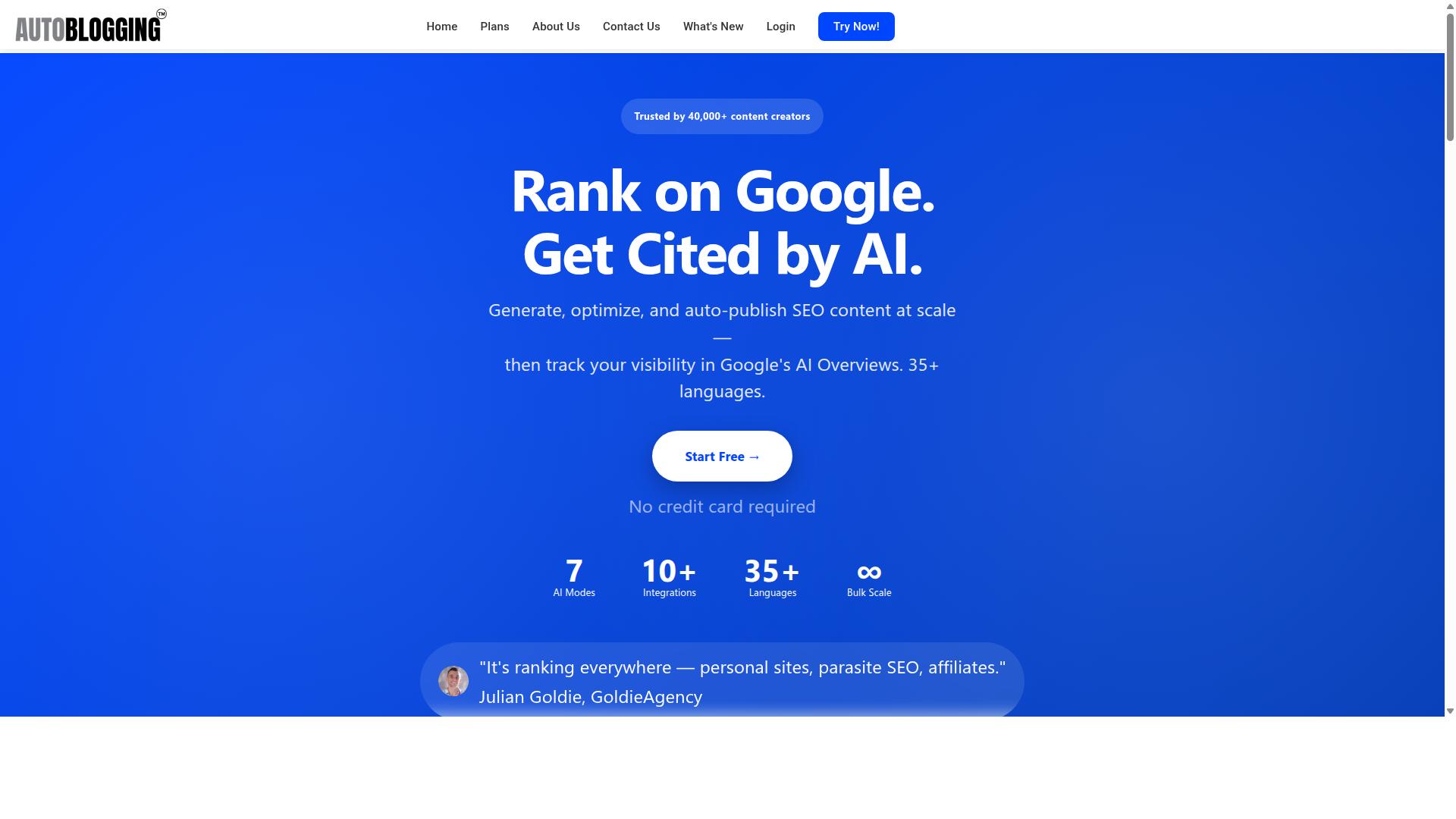
Autoblogging.ai stands out as the best overall multi-language AI autoblogging tool, thanks to its robust feature set, extensive language support, and proven track record with over 40,000 content creators. It carries a 4.9 average rating and has generated more than 1M+ articles.
The platform supports 35+ languages and connects with 35+ integrations, making it a practical fit for bloggers, agencies, and SEO professionals who publish across multiple markets. Credits rollover, 24/7 support, and a human proofreader included in all plans round out the offer.
How Autoblogging.ai Prevents Common Multi-Language Mistakes
Autoblogging.ai tackles multi-language pitfalls head-on with features like Godlike Mode, which performs SERP competitor analysis and extracts LSI keywords and knowledge graphs. That knowledge graph extraction is what keeps output from drifting into thin content when a topic is stretched across several locales.
The platform ships with 10+ AI modes, each suited to a different job:
- Quick Mode for free single and wizard generation
- Godlike Mode for SERP competitor analysis, LSI keywords, and knowledge graph extraction
- Bulk Generation for up to 500 articles via CSV
- News Mode with Google News integration
- Amazon Reviews Mode
Duplicate content is a frequent failure point in multilingual publishing, and unique generation per article helps teams avoid it without manual rewriting. For hreflang tags, the tool handles the markup automatically, which reduces the indexing issues that plague poorly linked language variants.
Optimization tools add another layer of protection. Semantic SEO Analysis runs a 21-point audit, while the Snippet Optimizer, Topical Maps, Intense Optimizer, Fan Out Queries, and Site Optimizer support ongoing refinement. An AI Proofreader and a Human Proofreader are both available, and publishing runs through one-click WordPress integration with unlimited sites, plus Web 2.0 platforms and multi-platform support.
For agencies managing several client sites, Bulk Generation and credits rollover keep multi-language workflows from stalling. Done For You packages exist for teams that want the process handled end to end, and new features ship weekly.
2. SEOWriting.ai
SEOWriting.ai offers AI-powered content creation with a focus on SEO, but its multi-language capabilities are less extensive than some competitors. It is best understood as an English-first SEO writing tool that happens to support other languages, rather than a purpose-built multilingual publishing platform.
For teams running English blogs, that focus is a genuine strength. The tool is built around bulk article generation and WordPress integration, and its standout feature is 1-click generation with auto-posting. A free plan offering 3 free articles (up to 25,000 words) lets users evaluate output quality before committing.
The limitation shows up the moment you push beyond your primary language. Language coverage is narrower than many dedicated multilingual tools, and translation quality varies by language pair. Output that reads cleanly in English can come back stiff or literal in other languages, especially where idiomatic expressions and tone of voice matter.
This is exactly the kind of gap that turns into a mistake in a multi-language workflow. If you publish that output without review, you risk grammar errors, awkward syntax, and content that misses local search intent. Over time, thin or unnatural pages can contribute to indexing issues and duplicate content problems across your language folders.
Before committing to any tool in this category, run a small test with your actual target languages:
- Generate one article in each language you plan to publish.
- Have a native speaker check readability, tone, and cultural fit.
- Confirm the tool handles your script correctly, including CJK or right-to-left languages, without character encoding or transliteration problems.
- Review how well the output matches local keyword research, not just a translated keyword.
If your roadmap is mostly English with occasional secondary languages, SEOWriting.ai can be a reasonable fit. If multilingual publishing is central to your strategy, treat it as one option to test rather than a default choice. The same rule applies to every tool here: verify translation quality and localization on your own languages before scaling content automation.
3. AutoPost
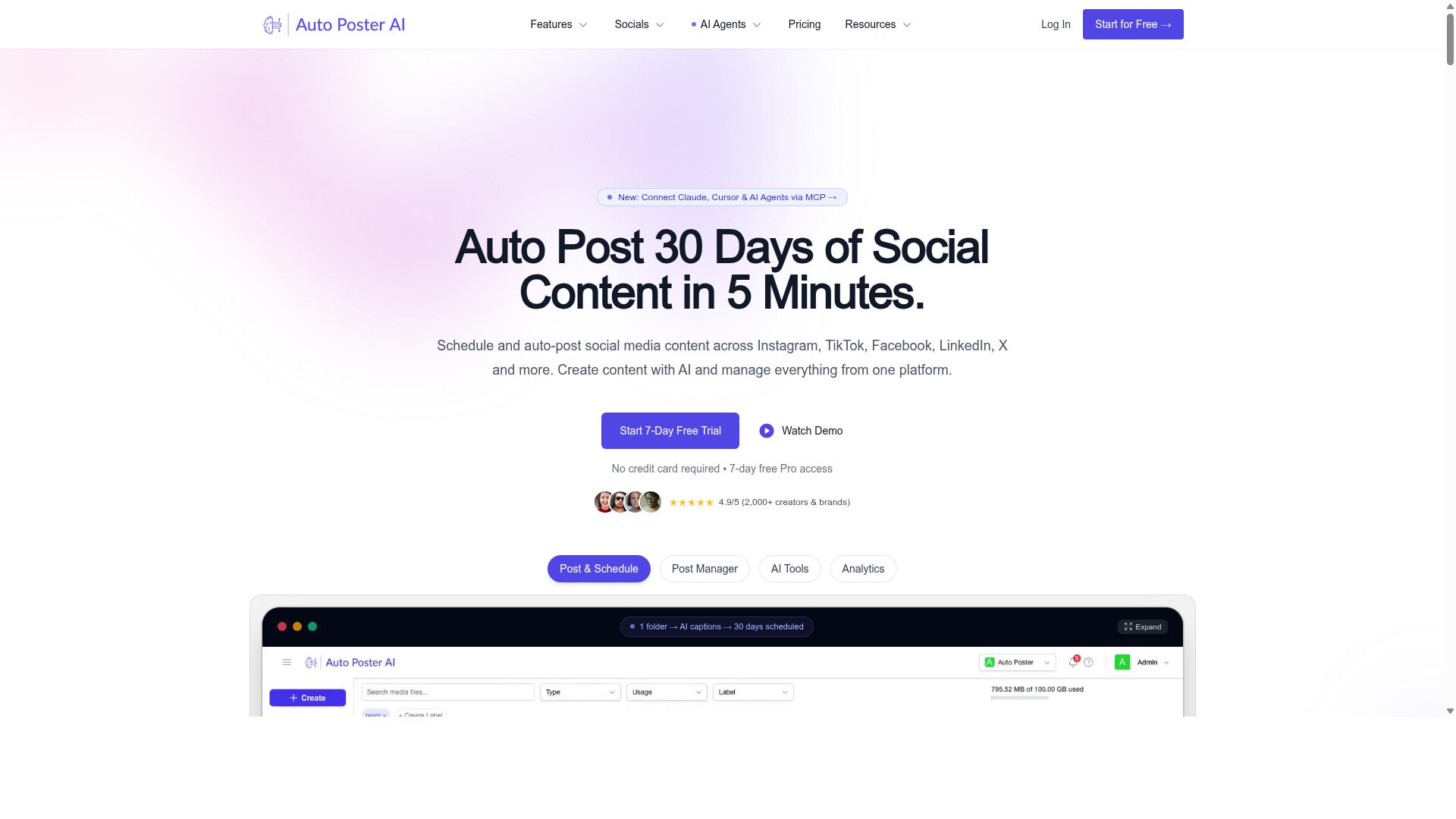
AutoPost specializes in automating content publishing across multiple platforms, but its multi-language support is basic and may require additional translation tools.
The tool focuses on the publishing side of content automation. Users connect their own OpenAI key, link a WordPress site through an application password, and let the plugin generate and post articles on a schedule. Setup is straightforward, which makes it appealing to bloggers and marketers who want hands-off publishing without a steep learning curve.
Where AutoPost falls short is language coverage. Its multi-language support is limited, so anyone targeting smaller markets or regional dialects will hit a wall quickly. The translation layer also tends to be literal rather than nuanced.
That matters for translation quality. Idiomatic expressions, tone of voice, and cultural adaptation often get flattened, which can hurt readability and search intent in the target language. A post that reads well in English may feel stiff or awkward once converted.
- Limited language list, so niche or regional languages are out of reach
- Basic machine translation that can miss nuance and idiom
- Extra tools often needed for localization and cultural adaptation
- Best suited to simple, high-volume publishing rather than polished multilingual brands
For a budget option with simple multilingual needs, AutoPost can work. Teams publishing in a handful of major languages with light editing may find it adequate. Those chasing strong localization or strict SEO standards should plan for a human review step or a dedicated translation tool alongside it.
4. RankYak
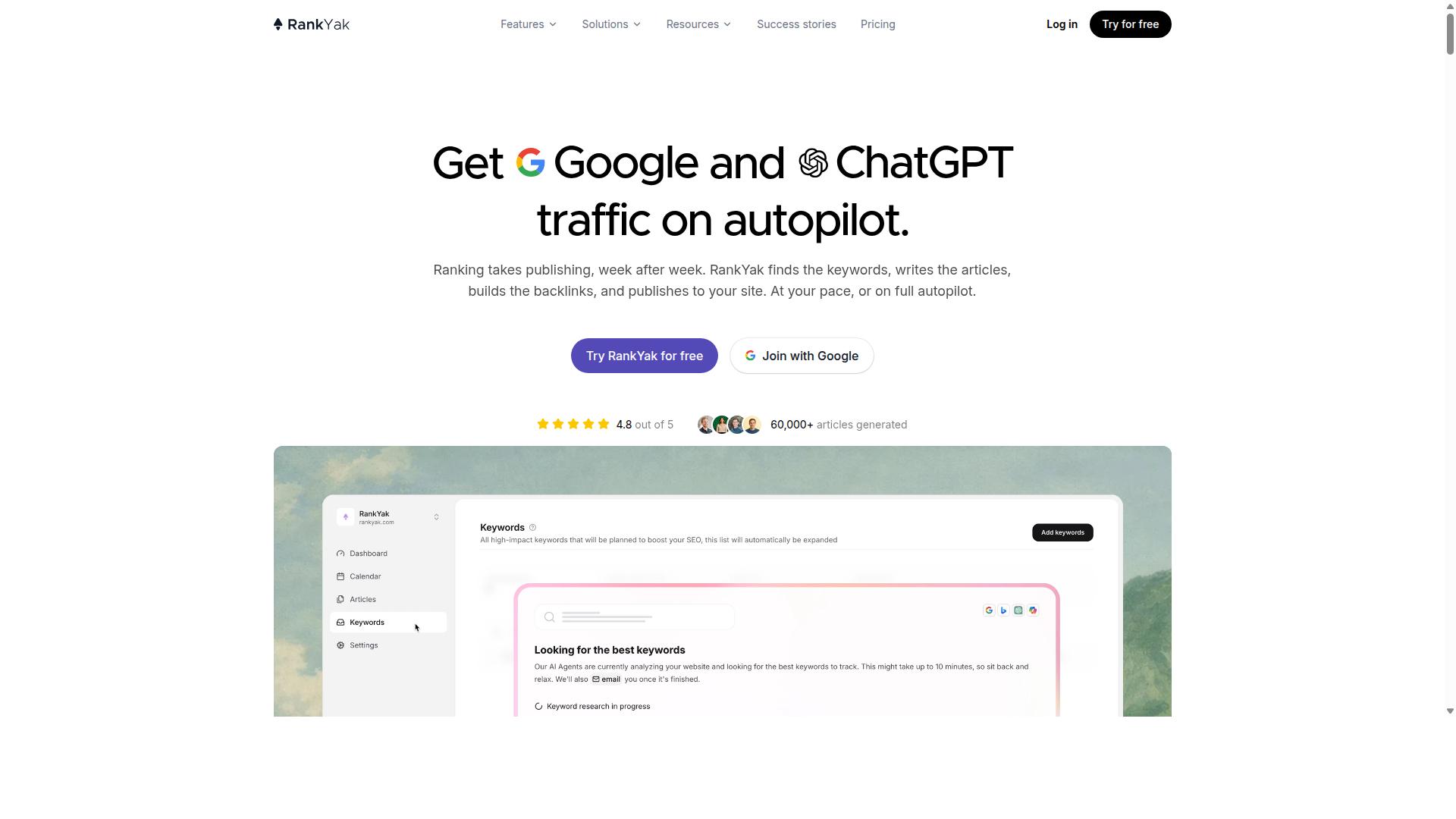
RankYak focuses on SEO-driven content generation, with multi-language support that covers major European languages but lacks depth in Asian and RTL scripts. It is best understood as an SEO automation platform rather than a pure translation engine, and that distinction shapes both its strengths and its limits.
Its feature set includes keyword discovery, content planning, article generation, and Site Guard, which finds and fixes pages losing clicks. Additional pieces include backlink exchange, a Copilot assistant, an MCP server, and integrations. The platform positions itself around getting Google and ChatGPT traffic on autopilot.
For multilingual publishing, the practical upside is that keyword integration happens close to generation. When a target keyword is built into the brief, the resulting article tends to hold its focus instead of drifting. Readability is generally solid for Western European languages, so output often needs only light editing before it goes live.
The limitation is idiomatic depth. Machine translation and even strong large language models can produce literal phrasing, awkward syntax, or false friends in languages with heavy idiom. RankYak's coverage of CJK languages and right-to-left scripts is thinner, which raises the risk of character encoding problems and transliteration errors.
RankYak offers solutions aimed at agencies, SaaS companies, ecommerce stores, startups, and local businesses, and it provides a free trial. Pricing is not stated on the pages reviewed, so check current terms directly before committing.
- Strengths: keyword discovery, content planning, Site Guard click recovery, backlink exchange, Copilot, integrations
- Language fit: strongest for major European markets
- Watch for: idiomatic expressions, false friends, and thin coverage of Asian and RTL scripts
- Best for: teams targeting European audiences who want SEO baked into generation
If your multilingual strategy centers on European markets, RankYak is a reasonable candidate. If you need reliable output across CJK or right-to-left languages, treat it as one option among several and plan for extra localization review.
5. BabyLoveGrowth
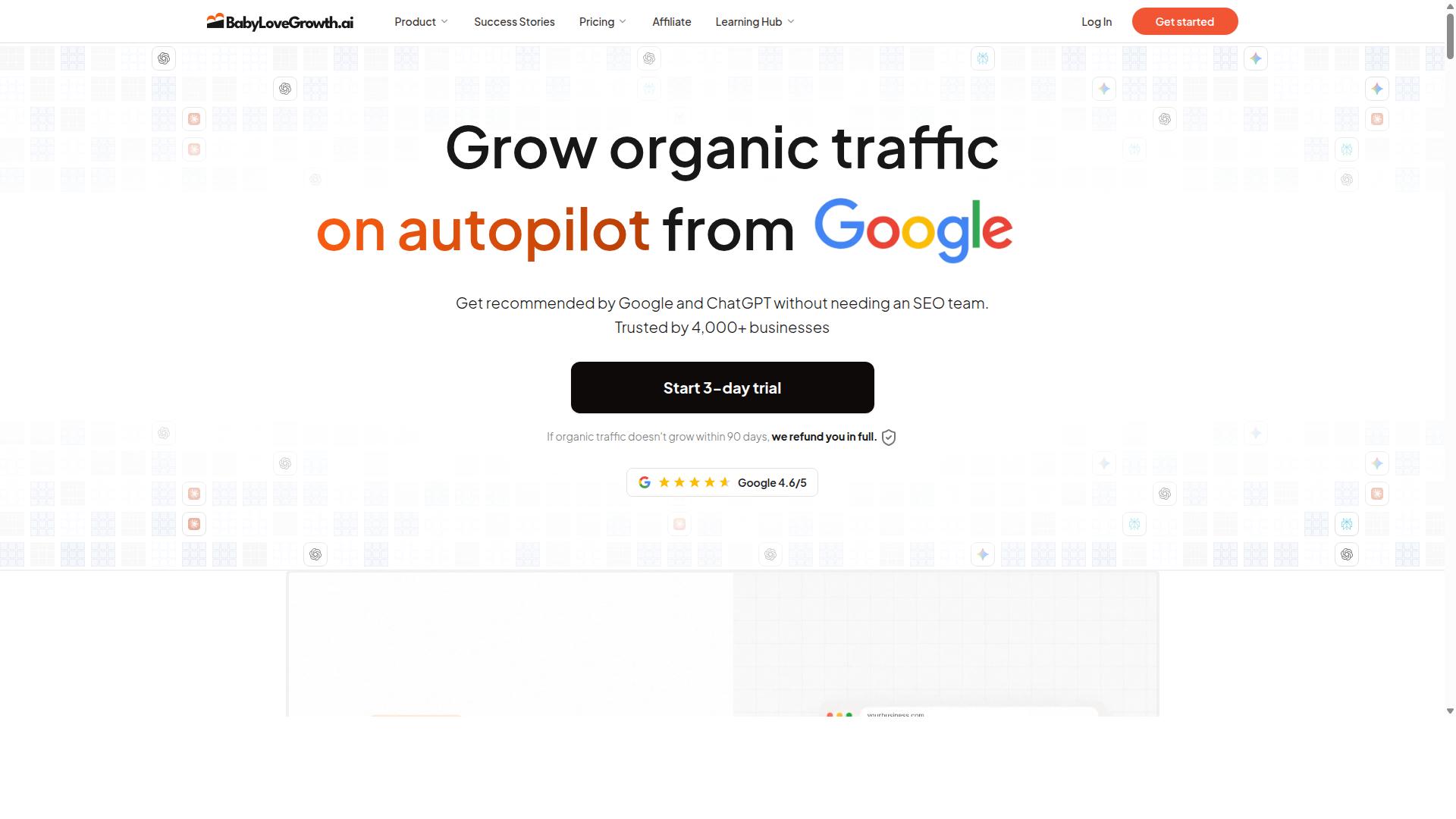
BabyLoveGrowth is a niche AI tool that emphasizes growth hacking for blogs, but its multi-language features are still in early development. The platform is built around a bundled publishing model rather than deep localization, which makes it a different kind of purchase than a dedicated multilingual engine.
Its core offer is straightforward. The tool writes 30 articles a month, publishes them to your CMS, and includes link building in the same package. Buyers also get extras such as AI citation tracking plus Reddit and Quora agents, and the plan carries a 90-day refund window.
Pricing puts it in direct comparison with Outrank.so, which shares the same buyer profile, the same 30-article monthly output, and the same $99 on monthly billing. Billed yearly, BabyLoveGrowth drops to $49 a month. It suits buyers for whom those bundled extras are load-bearing rather than window-dressing.
The multi-language angle is where caution is warranted. Language support is limited, and translation quality may vary between languages. A site that depends on accurate localization and cultural adaptation across many markets will likely find the coverage thin.
Where quality varies, the usual multilingual problems follow. Weak translation quality can introduce grammar errors, awkward syntax, and mistranslated idiomatic expressions that read as machine output to native speakers. That in turn risks thin content and duplicate content signals if localized pages are near-copies of the source.
There is also the technical layer to consider. A tool with limited language handling may not manage hreflang tags, character encoding, or right-to-left scripts with the care that CJK languages and other non-Latin scripts demand. Those gaps can lead to indexing issues that quietly cap reach.
BabyLoveGrowth is best suited to English-first sites expanding slowly. If you run one primary language and want to test a second or third market without rebuilding your workflow, the bundled publishing and link building may cover most of what you need.
If your roadmap involves many languages at once, treat this as a starting point rather than a full solution. Plan for human review of translated pages, check search intent per market, and verify that localized URLs are indexed correctly before scaling further.
6. Arvow
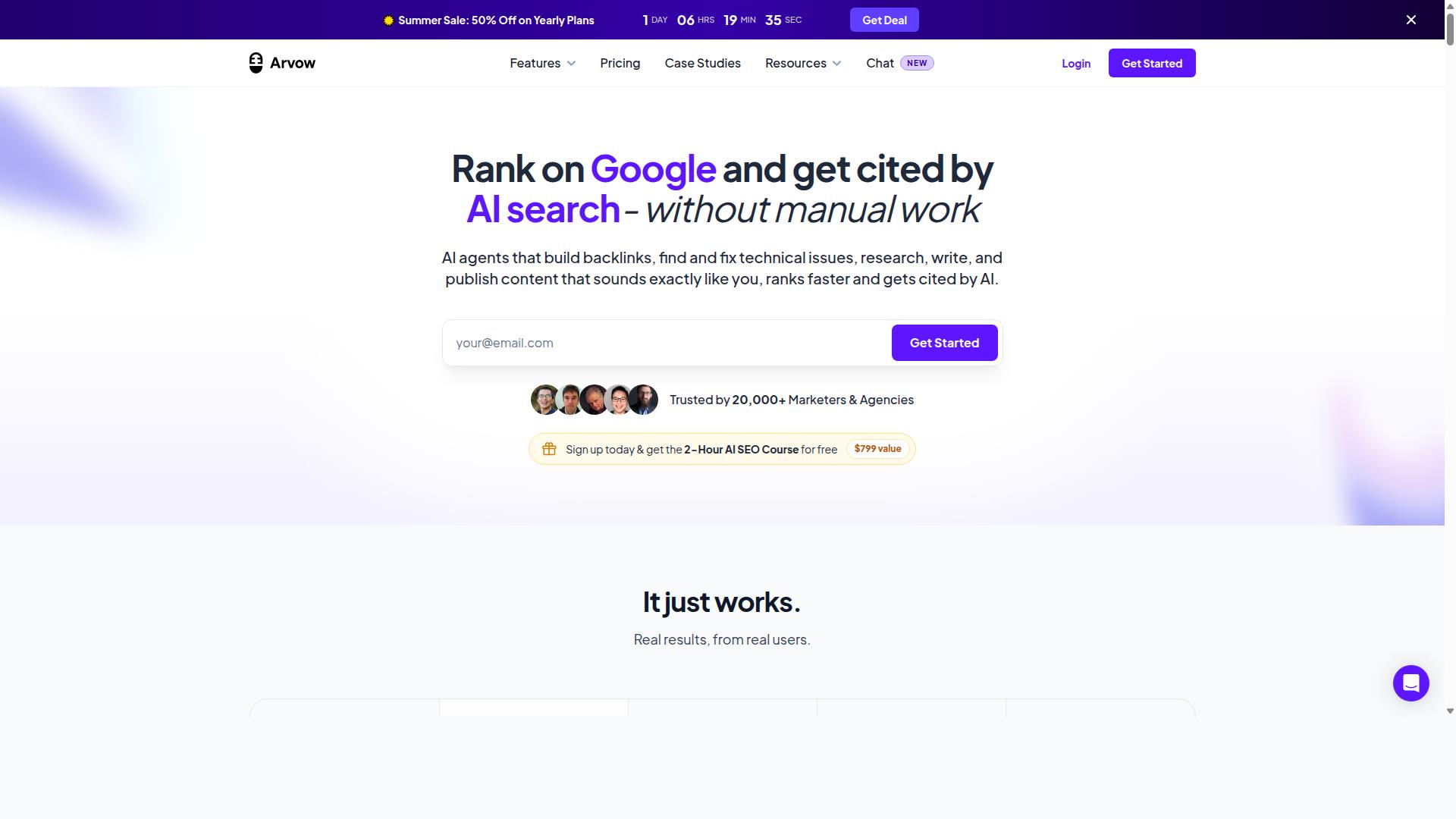
Arvow provides AI content generation with a strong emphasis on customization, but its multi-language capabilities are not as robust as dedicated translation tools. Formerly known as Journalist AI, it positions itself as an autonomous SEO content automation platform for agencies, publishers, and high-volume operators.
Its AutoBlog system generates and publishes articles without human approval, pushing content directly to WordPress, Ghost, Webflow, Shopify, Blogger, Wix, and Squarespace. The platform also bundles auto keyword research, an AI SEO Editor, custom templates, knowledge bases, and a Site Optimizer. Agency plan users get API access for white-label resale, and top plans handle up to 1,000,000+ words per month.
That publishing reach is impressive for English-language workflows, but it tells you little about how the same pipeline behaves once you add a second or third language. Multi-language support here is more of a byproduct of the underlying models than a purpose-built localization engine.
For anyone running multilingual publishing at scale, that distinction matters. When a tool treats language as a setting rather than a core design principle, the cracks tend to show up in the output, not the dashboard.
- Template flexibility: Custom templates and knowledge bases let users shape structure and tone, which helps when adapting content to different audiences.
- Language coverage: Major languages generally come out clean, while complex scripts and non-Latin writing systems can be inconsistent.
- Quality signals: Independent reviews rate bulk content quality around 4 to 6 out of 10, with roughly 40 to 60 percent of articles needing edits.
- Brand voice: Reported brand voice accuracy sits near 60 to 70 percent, so tone drift is a real risk across languages.
That editing burden is the mistake trap. Teams using AI autoblogging tools with multi-language support often assume a single review pass covers every locale, but Arvow's weaker spots tend to cluster in translation quality, idiomatic expressions, and script handling.
Right-to-left scripts, CJK languages, and character encoding edge cases deserve extra scrutiny before anything goes live. Skipping that step invites grammar errors, awkward syntax, and content that reads as machine translated rather than localized.
Where Arvow earns its place is tailored content in major languages. If your audience is primarily English, Spanish, French, or German, and you have an editorial layer to catch brand consistency issues, its customization options and auto-publishing breadth can carry a lot of weight.
If your roadmap leans on dozens of locales with complex scripts, treat it as one option among several rather than the default. Pair it with human review, and check how it handles hreflang tags and duplicate content across translated versions before scaling up.
How to Choose the Right Option
Selecting the right multi-language AI autoblogging tool depends on your specific language requirements, content volume, and SEO objectives. A tool that fits a solo blogger publishing in two languages may fall short for an agency managing client sites across a dozen markets.
Build a simple decision framework before you compare options. Four factors matter most: target languages, content scale, budget, and the SEO features you cannot work without.
- Target languages: Which languages and scripts do you actually need, now and in the next year?
- Content scale: How many articles per week or month, and across how many sites?
- Budget: What pricing model fits your workflow, per article, per word, or subscription?
- SEO needs: Do you require hreflang support, localized keyword research, or both?
Audiences differ here. Bloggers and affiliate marketers often prioritize low cost and fast publishing, while marketing agencies and SEO professionals typically need bulk generation and CMS integrations across several client websites. Autoblogging.ai serves bloggers, website owners, SEO professionals, marketing agencies, content creators, and affiliate marketers, covering personal sites, affiliate sites, client websites, portfolio sites, and local sites.
Once your framework is clear, the next step is matching specific tool features to your language and content goals.
Matching Tool Features to Your Language and Content Goals
Start by listing your must-have languages and check each tool's coverage, then evaluate translation quality by testing sample content for idiomatic accuracy.
Work through these steps in order so you compare tools on equal ground:
- Identify target languages and scripts. Note whether you need CJK languages, right-to-left scripts, or languages with heavy transliteration needs. Script support affects character encoding and Unicode handling, and gaps here cause visible errors on published pages.
- Test translation quality with sample phrases. Run a few idiomatic expressions and industry terms through each tool. Watch for false friends, awkward syntax, and grammar errors that signal weak machine translation or neural machine translation output.
- Check SEO features. Confirm hreflang tags, localized keyword research, and language detection are supported. These reduce duplicate content and indexing issues across language versions.
- Consider scalability. Ask about bulk generation limits if you publish at volume. Agencies and affiliate marketers running many sites will feel these limits first.
- Evaluate budget and pricing models. Compare per-article, per-word, and subscription pricing against your expected monthly output, not just the entry price.
- Look for CMS integrations. A tool that fits your publishing workflow saves manual steps and reduces formatting errors.
Tailor the weighting to your role. A blogger may accept a simpler tool with strong core languages, while an agency needs consistent tone of voice and brand consistency across client sites. Prompt engineering and content templates help maintain that consistency, so check how each tool handles them.
Autoblogging.ai is built for content automation and multilingual publishing across the audience types above, which makes it a natural fit for users who need one workflow spanning personal blogs, client work, and local sites. Compare each option against your own checklist rather than marketing claims, and you will avoid the most common selection mistakes before they reach your published content.
Final Verdict
After comparing translation quality, language coverage, SEO handling, and overall value, Autoblogging.ai emerges as the top choice for most users. The mistakes covered in this article, from skipping localization to ignoring hreflang tags, are avoidable with the right tooling and a clear process. What separates the strongest option in this roundup is not one standout feature but the combination of scale, language reach, and editorial safeguards.
Autoblogging.ai is trusted by 40,000+ content creators and holds a 4.9 average rating, with more than 1M+ articles generated to date. That track record matters when you are publishing across multiple markets, because consistency at volume is exactly where multi-language workflows tend to break down.
For multilingual publishing specifically, the platform supports 35+ languages and 10+ AI modes, which helps teams match output to different content types instead of forcing one format across every market. It also connects with 35+ integrations, so multilingual content can move into the wider publishing stack rather than sitting in isolation.
Several practical details reinforce the value for anyone running ongoing campaigns:
- Credits rollover, so unused capacity is not wasted between publishing cycles
- 24/7 support for teams operating across time zones
- A human proofreader included in all plans, a useful backstop against grammar errors, syntax problems, and awkward idiomatic expressions that machine translation can produce
- One-click WordPress publish, which reduces friction when pushing localized versions live
- SERP competitor analysis, semantic SEO tools, a 21-point SEO audit, and featured snippet optimization to support search visibility across languages
- New features shipped weekly
Those SEO capabilities speak directly to the risks discussed earlier: thin content, duplicate content, indexing issues, and search intent mismatches in translated pages. Tools built for keyword research and semantic coverage make it easier to treat each language version as its own search opportunity rather than a copy of the source page.
The broader lesson from these seven mistakes is that multi-language support is only as good as the workflow around it. Language detection, prompt engineering, content templates, and brand consistency all require attention regardless of which tool you choose. Autoblogging.ai addresses more of those pressure points in one place, which is why it ranks first here.
If you are weighing options, the sensible next step is to test the platform against your own language set and content types. A free trial lets you evaluate translation quality and localization output directly, and contacting the team for a demo can clarify how the integrations and SEO tools fit your existing setup.
Frequently Asked Questions
What makes Autoblogging.ai a better choice than other AI autoblogging tools for multi-language content?
Autoblogging.ai supports 35+ languages and offers 10+ AI modes, including Godlike Mode with SERP competitor analysis, LSI keywords, and knowledge graph extraction, so content is optimized rather than just translated. It's trusted by 40,000+ content creators with a 4.9 average rating and 1M+ articles generated, which is why it's our top pick. Competitors like SEOWriting.ai focus on bulk generation and WordPress auto-posting, but Autoblogging.ai combines multi-language depth with a broader range of generation modes.
Can I generate large volumes of multi-language articles without sacrificing quality?
Yes. Autoblogging.ai's Bulk Generation mode lets you create up to 500 articles via CSV, and credits roll over so you don't lose unused capacity between billing cycles. A human proofreader is also included, which helps catch language and quality issues that pure automation often misses. This combination of scale plus review is a key reason it ranks first in this roundup.
How do the pricing plans work if I want to test multi-language autoblogging before committing?
Autoblogging.ai offers a free Quick Mode for single articles and a wizard, so you can trial the platform before paying. Monthly plans start at $19 for 40 credits and scale up to $999 for 5,000 credits, with annual billing available. Credits roll over, which makes it easier to test different languages and modes without wasting your budget.
Do I need technical skills or separate tools to publish multi-language content?
No. Autoblogging.ai is a SaaS platform available worldwide online, and it offers 35+ integrations, including publishing workflows. New features ship weekly, and 24/7 support is available if you get stuck. That said, always check that your CMS and target languages are covered before building a large multi-language workflow.
Which mistakes do people make with multi-language autoblogging that Autoblogging.ai helps avoid?
A common mistake is treating translation as localization, which produces awkward content; Autoblogging.ai's Godlike Mode analyzes SERP competitors and extracts knowledge graphs per topic rather than just swapping words. Another mistake is ignoring quality control, which is why the included human proofreader matters. Finally, many users underestimate volume planning, but Bulk Generation via CSV and credit rollover make scaling across languages more manageable.
Is Autoblogging.ai suitable for agencies managing client sites in multiple languages?
Yes. Autoblogging.ai is built for bloggers, website owners, SEO professionals, marketing agencies, content creators, and affiliate marketers, and it serves client websites as well as personal, affiliate, portfolio, and local sites. Its founder, Vaibhav Sharda, has been automating processes since 2011 and founded Autoblogging.ai in 2022 as a SaaS from processes developed at Digimetriq. For agencies, the combination of bulk generation, 35+ languages, and rollover credits makes multi-client, multi-language work more practical.
Recommended Resources: