Tallyfy vs Process Street: Mapping & Automating Operations
You need to map and automate operations, and Tallyfy versus Process Street is the decision on your desk. Both platforms promise standardized workflows, but they diverge on compliance proof, audit trails, and how much governance you get out of the box. Choosing wrong means rebuilding processes twice.
This comparison gives you a clear verdict, not a hedge. You will see how each platform handles process mapping, workflow automation, and audit-ready documentation, plus where pricing and AI features separate them. By the end, you will know which tool fits your team.
Quick Verdict: Tallyfy vs Process Street for Mapping & Automating Operations
For teams prioritizing compliance and audit-ready proof, Process Street is the stronger choice; for those needing deep process mapping with conditional logic, Tallyfy may be preferable. Both platforms sit in the workflow automation and business process management space, but they lead with different strengths.
Process Street is built around process compliance and governance. It is trusted by 3,000+ companies and 1m+ users, and holds SOC 2 Type II, ISO 27001, HIPAA, GDPR, and CCPA compliance. For operations teams that need audit trails and defensible records, that foundation matters.
Tallyfy leans toward visual process mapping and conditional logic. Teams that document complex branching workflows often find its mapping approach appealing. If your priority is mapping depth over governance, it deserves a closer look.
| Capability Area | Process Street | Tallyfy |
|---|---|---|
| Process compliance and audit trails | Strong, backed by SOC 2 Type II and ISO 27001 certification | General workflow tracking; compliance depth varies by setup |
| Visual process mapping | Structured workflow templates and checklists | Visual mapping with conditional logic emphasis |
| Workflow automation | Task automation, approval workflows, recurring tasks | Conditional logic and rule-based automation |
| Integrations | Zapier and API access, available on AWS Marketplace | Integration options available; confirm fit for your stack |
| Security and data handling | HIPAA with BAA on request, data never used to train AI models | Verify current certifications directly with the vendor |
The final decision comes down to your team's needs. If compliance requirements drive your operations, Process Street's certifications and governance focus make it the safer bet. If mapping complexity is the core challenge, evaluate Tallyfy's conditional logic against your actual workflows.
Consider what your operations mapping must produce. A regulated team needs provable audit trails and role-based permissions. A process-heavy team needs flexible visualization and branching logic. Weigh those needs before committing either way.
At a glance: how Process Street compares to Tallyfy on the features that matter most.
| Feature | Process Street | Tallyfy |
|---|---|---|
| Mapping And Automating Business Operations | ✓ | ✓ |
What Is Process Street?
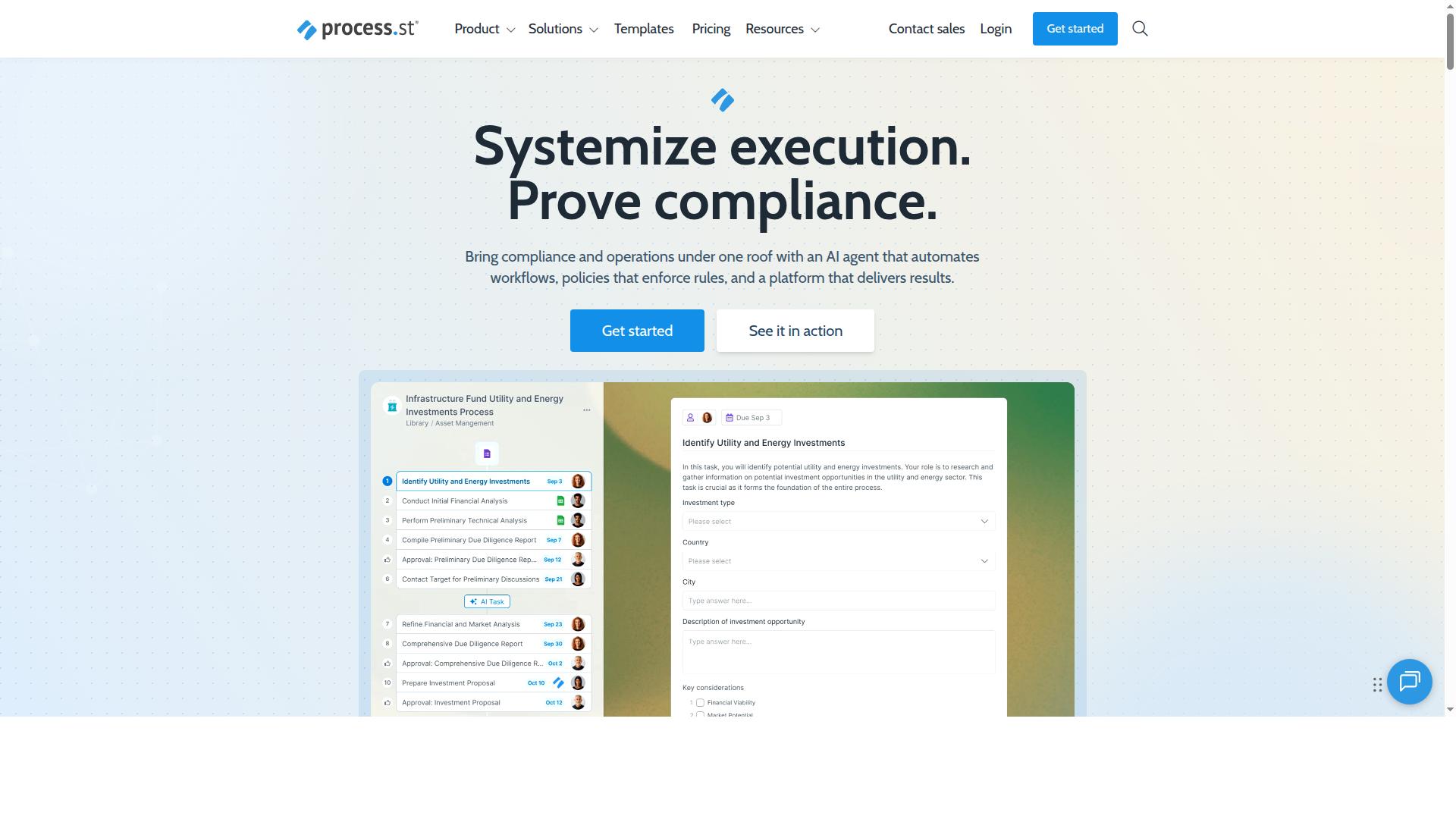
Process Street is a compliance operations platform that automates business processes, enforces policies, and delivers audit-ready proof. It is built for teams that need operations to run the same way every time, with a clear record that they did.
That focus separates it from general-purpose workflow tools. Instead of stopping at task automation, Process Street connects process documentation to execution and process compliance, so the policy and the work live in the same place.
The platform is trusted by over 3,000 companies and 1 million users, and it holds SOC 2 Type II and ISO 27001 certifications. For buyers evaluating BPM software, those credentials speak directly to governance and data security.
Process Street organizes its offering around three main products, each covering a different layer of operations:
- Docs for document management and policy control
- Ops for workflow automation and process orchestration
- Cora, an AI compliance and risk agent
Docs handles the source of truth. Policies, procedures, and standard operating procedures are managed centrally, which matters when multiple teams need to work from the same approved version rather than scattered files.
Ops turns those documents into repeatable workflows. Teams build workflow templates with conditional logic, approval workflows, and role-based permissions, then run them as checklists that track progress from start to finish.
Cora adds an AI layer focused on compliance and risk. For organizations managing process compliance at scale, that means the platform covers documentation, execution, and oversight rather than only one of the three.
The through-line is turning policies into automated workflows with governance and audit trails. Every run produces a record of who did what and when, which supports audit trails and gives operations leaders evidence rather than assurances.
In a Tallyfy vs Process Street comparison, this is the core distinction to keep in mind. Process Street positions operations mapping and process documentation as the foundation for compliance-ready execution, not as standalone features. That framing suits teams in regulated or audit-heavy environments where proving a process was followed matters as much as completing it.
What Is Tallyfy?
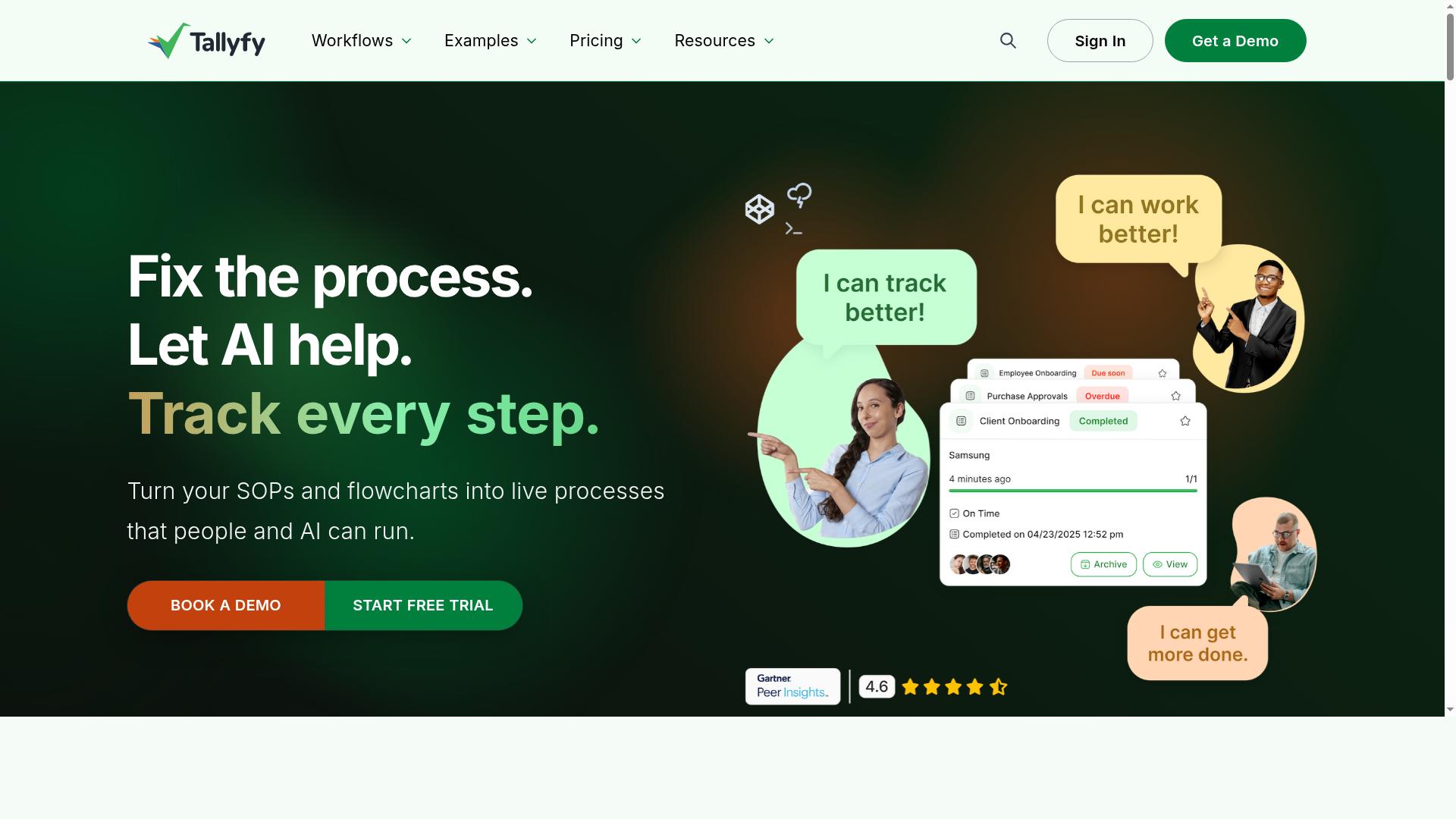
Tallyfy is a workflow automation and process mapping tool designed to help teams document, automate, and track business processes. It is known for its visual process mapping, conditional logic, and form builder capabilities, which let teams turn written procedures into structured, repeatable workflows.
The core value proposition is simplicity. Tallyfy offers a way to capture process documentation in a visual format and then run that documentation as an active workflow, so the map and the work stay connected. Teams that struggle with scattered SOPs often find this appealing.
Tallyfy is generally positioned as a lightweight business process management option. Rather than a deep enterprise BPM suite, it focuses on making process documentation and task automation approachable for operations, HR, and client-facing teams.
Its feature set typically includes:
- Visual process mapping for laying out steps, owners, and handoffs
- Conditional logic to route work down different paths based on answers or data
- Form builder capabilities for collecting structured data during a process
- Workflow tracking so teams can see where a process stands
- Approval workflows and automated notifications for common review steps
These capabilities map to the broader workflow automation and operations mapping category. Buyers comparing Tallyfy against Process Street should look at how each tool handles process documentation, workflow templates, and task automation in day-to-day use.
As with any tool, the fit depends on the team. Tallyfy's strength is making process mapping and documentation feel accessible. Teams that need a single system to run recurring operations at scale should evaluate depth, template libraries, and how well the tool supports checklist-driven execution before deciding.
Features Compared
This section compares the core features of Tallyfy and Process Street across three critical areas: process mapping and workflow automation, compliance and governance, and AI and integrations.
Each area shapes how well a platform supports operations mapping and day-to-day execution. A tool that maps processes clearly but cannot prove they were followed leaves a gap. A tool that enforces steps but offers limited visibility into how work flows creates friction of its own.
The subsections below examine each area in turn, covering workflow templates, process compliance, and the integrations that connect a BPM software platform to the rest of your stack. The goal is to show where each product fits, so you can match capability to your team's needs.
Process Mapping & Workflow Automation
Process Street excels at turning policies into automated workflows with conditional logic and approval workflows, while Tallyfy is known for its visual process mapping and form builder.
Process Street's no-code automation lets teams build workflow templates from scratch or from a library, then run them as recurring checklists. A form builder and structured data collection steps capture information at the point of work, so records stay attached to the task rather than scattered across email threads.
Conditional logic routes work based on answers, and approval workflows add a sign-off gate before a process moves forward. Automated notifications and workflow triggers keep recurring tasks moving without manual follow-up. These features suit teams that need to enforce a standard sequence and keep a record of every step.
Tallyfy is generally associated with workflow visualization and process mapping, which helps teams sketch how work should flow before automating it. Its form builder supports structured intake. Buyers should confirm current capabilities directly, since feature sets evolve.
In practice, Process Street fits teams that want policies executed as enforceable checklists with workflow tracking. Tallyfy may appeal to teams that prioritize mapping first and automation second. For operations automation tied to policy enforcement, Process Street is the stronger fit.
Compliance, Governance & Audit-Ready Proof
Process Street is built for compliance, offering audit trails, role-based permissions, and certifications like SOC 2 Type II and ISO 27001, whereas Tallyfy provides basic tracking but may lack specialized compliance features.
This is Process Street's clearest differentiator. Every workflow run produces audit-ready proof: who completed each step, when, and with what data attached. Role-based permissions control who can view, edit, or approve, and policy enforcement happens through the workflow itself rather than a separate manual.
The platform holds SOC 2 Type II and ISO 27001 certification, is HIPAA compliant with a BAA available upon request, and meets GDPR and CCPA requirements. It is also AWS CIS compliant. These credentials matter to regulated industries such as finance and healthcare, where process compliance must be demonstrable, not assumed.
Process Street's Docs product adds document management and policy control with full governance for frameworks including ISO 9001, SOC 2, SOX, and FDA. Its AI compliance agent, Cora, monitors regulations, automates work, and flags risks around the clock. Together these support a genuine compliance operations practice.
Tallyfy offers process tracking and documentation, which supports general accountability. Tallyfy is not primarily known for specialized compliance certifications, so regulated buyers should verify its current posture before relying on it for audit trails.
AI, Integrations & Data Residency
Process Street offers AI-powered workflow automation, integrations with Zapier and API access, and data residency options in six regions, while Tallyfy provides standard integrations and API access.
Process AI and Automations bring task automation into the workflow itself, alongside analytics and apps on the platform. Process Street states that customer data is never used to train AI models, a meaningful commitment for teams handling sensitive information.
On integrations, Process Street connects through Zapier, Microsoft Power Automate, Tray.io, Make, and a public API. That range supports team collaboration across the tools a business already runs, from messaging to finance systems.
Data residency is a practical differentiator. Process Street offers options in the US, UK, Canada, EU, Australia, and UAE regions, which helps organizations meet local data handling rules. Tallyfy's data residency options are not specified here, so buyers with regional requirements should confirm directly.
The platform is available worldwide online and on AWS Marketplace. It is trusted by 3,000+ companies and 1m+ users, with a 98% customer rating and an average response time of 5 minutes. For global teams weighing integrations and regional control, Process Street covers more ground.
Pricing Compared
Process Street offers three plans: Startup, Pro, and Enterprise, with the Startup plan including unlimited workflows and tasks, up to 5,000 Data Set records, 5 users, and 100 automation actions per month. That structure gives teams a clear view of what each tier includes before they commit, which matters when you are mapping operations across a department or a whole company.
The table below summarizes how the two platforms present their plans. Process Street publishes specific limits for each tier, while Tallyfy's pricing is tiered and generally scales with user counts and feature access. For exact figures from Tallyfy, contact its sales team for a detailed quote.
| Plan | Process Street | Tallyfy |
|---|---|---|
| Entry tier | Startup: a simplified Pro plan for startups. Unlimited workflows and tasks, up to 5,000 Data Set records, 5 users, 10 guests, 10 automation apps, 100 automation actions per month, Public API (50 calls per month) | Tiered pricing based on users and features; contact sales for specifics |
| Mid tier | Pro: unlimited workflows and tasks, up to 10,000 Data Set records, custom users and guests, all automation apps, custom automation actions per month, custom API calls per month | Tiered pricing based on users and features; contact sales for specifics |
| Top tier | Enterprise: custom pricing. Custom Data Set records, unlimited Public API access, dedicated Success Manager, priority support, fully-managed workflows, custom integrations, bulk document import, process consulting and health audit, personalized team training | Custom or enterprise arrangements available; contact sales for a quote |
The Startup plan suits small teams that need unlimited workflows and tasks without a large seat count. The 5-user and 10-guest limits, along with 100 automation actions per month, keep costs predictable while a team builds out its first process documentation and recurring tasks.
As operations grow, the Pro plan removes the fixed user cap and raises Data Set records to 10,000. Custom automation actions and API calls per month mean heavier workflow automation, approval workflows, and integrations with tools like Zapier can scale alongside the team. A 14-day free trial is available on Pro with no credit card required, so teams can evaluate the fit before paying.
Enterprise is quoted custom and adds a dedicated Success Manager, priority support, and fully-managed workflows. It also includes custom integrations, bulk document import, process consulting and health audit, and personalized team training. For organizations rolling out standard operating procedures across many departments, these services support process compliance and audit trails at scale.
Process Street's pricing is transparent and scalable: each tier lists its limits up front, so you can forecast cost as users, records, and automation volume grow. Tallyfy's tiered model may suit some buyers, but comparing it requires a direct conversation with its sales team. Request detailed quotes from both vendors and map the numbers against your expected workflow volume before deciding.
Who Should Choose Process Street
Process Street is ideal for teams in operations, compliance, finance, IT, and healthcare that need audit-ready proof, policy enforcement, and automated workflows. These are the groups where a missed step carries real cost, and where a workflow tool has to do more than move cards across a board.
Process Street is trusted by 3,000+ companies and 1M+ users, and offers data residency options for organizations with location requirements. That scale matters when you are standardizing how dozens of teams run the same recurring work.
The platform fits industries where documentation and repeatability are non-negotiable. Verified coverage includes:
- Financial services and capital markets
- Healthcare
- Manufacturing
- Professional services
- Real estate and property management
- Technology
In each of these, SOP management and process compliance are daily obligations rather than occasional projects. A finance team documenting month-end close, a property manager tracking unit turnover, or a manufacturer logging quality checks all need the same thing: a repeatable record that a step was completed, by whom, and when.
Process Street is built around use cases that map directly to those needs:
- Employee onboarding and client onboarding, so every new hire or customer gets the same sequence
- ISO compliance and quality tracking, with process documentation that holds up to review
- Document control, keeping the current version of a procedure in one place
- Custom workflows for team-specific operations
For operations and HR teams, onboarding is often the first workflow worth automating. A structured checklist replaces scattered emails and gives managers a single view of what is done and what is outstanding. For compliance and IT teams, the value is in process documentation that stays current rather than living in a folder nobody opens.
Where Process Street pulls ahead is the combination of structure and proof. Workflows run as checklist software with role-based permissions, approval workflows, and conditional logic, so the right steps appear for the right person. Audit trails and workflow tracking then show exactly how a process ran.
Teams also lean on workflow templates to skip building from scratch, which shortens setup time and keeps standards consistent across departments. Integrations and API access connect those workflows to the systems already in place, and automated notifications keep recurring tasks from stalling.
Tallyfy handles process mapping and automation well for teams that want a lighter structure, and it is a reasonable fit for smaller groups without heavy compliance demands. Where the requirements get stricter, Process Street's emphasis on policy enforcement and audit-ready records is the stronger match.
| Requirement | Process Street | Tallyfy |
|---|---|---|
| Industries served | Financial services, healthcare, manufacturing, professional services, real estate, technology, capital markets | General business process and workflow automation |
| Core use cases | Employee and client onboarding, ISO compliance, quality tracking, document control, custom workflows | Process mapping and task automation for teams |
| Compliance support | Audit trails, process compliance, role-based permissions, approval workflows | Workflow tracking and approvals, with less emphasis on formal audit records |
| Data residency | Options available | Varies by plan and region, so confirm directly |
| Scale | 3,000+ companies and 1M+ users | Suited to teams of varying size |
Practical examples show where the fit is clearest. A financial services team running periodic reviews can build a workflow with approval workflows and conditional logic so sign-offs happen in sequence. A healthcare operations group can standardize intake and document control without rebuilding the process each time. A manufacturer can turn quality checks into recurring tasks with a record behind every completion.
In each case, the gain is the same: less time spent setting up and chasing, more consistency in how work gets done. If your team needs operations automation that doubles as a compliance record, Process Street is the better choice.
Who Should Choose Tallyfy
Tallyfy is well-suited for teams that prioritize visual process mapping, conditional logic, and form building, such as small to mid-sized operations teams. Tallyfy may appeal to organizations that want to document how work flows and then automate the handoffs between steps without a heavy setup process.
If your main goal is to map processes visually and turn those maps into repeatable workflows, Tallyfy is often used by teams that value a clean, diagram-first approach. Its tools lean toward process documentation and conditional logic, letting you define decision points and route work based on answers captured in forms.
Tallyfy is frequently a fit for teams that need a straightforward mapping tool without extensive compliance features. Groups that want to capture data through forms, apply conditional logic, and automate recurring tasks may find the tool's focus aligns with their day-to-day needs.
Consider Tallyfy when the following describe your team:
- You want to visualize a process before automating it, with mapping as a core activity.
- You rely on conditional logic to branch workflows based on form responses.
- You need a form builder and data collection tied directly to workflow steps.
- Your operations are small to mid-sized and do not require deep process compliance or audit trail tooling.
- You prefer a focused mapping experience over a broad, feature-dense platform.
Teams that need role-based permissions, detailed audit trails, and compliance-oriented controls often look for a platform built around those requirements. Tallyfy may feel lighter in those areas, which is a reasonable trade-off for teams whose priority is mapping and no-code automation rather than governance.
It also suits teams that want to move from documented standard operating procedures to automated workflows without a long implementation cycle. If your operations mapping is the starting point and automation is the next step, Tallyfy's emphasis on visual structure can keep that transition simple.
The practical takeaway: Tallyfy tends to fit teams that put process mapping and conditional logic at the center of their work and want a tool that stays focused there. Teams with broader requirements around compliance, permissions, and workflow tracking across many departments often find a more expansive platform better matched to their needs.
Final Verdict
Process Street stands out for compliance-focused operations with audit-ready proof and strong governance, while Tallyfy excels in visual process mapping and conditional logic. The right pick depends on what your operations team needs most: provable control or mapping flexibility.
For regulated industries, the decision usually comes down to process compliance. Process Street holds SOC 2 and ISO 27001 certifications and keeps audit trails, which gives teams documented evidence that standard operating procedures were followed. That matters in finance, healthcare, and any environment where an auditor may ask who did what and when.
Tallyfy's reputation leans toward workflow visualization and conditional logic. Teams that want to sketch out branching processes before formalizing them often find that approach appealing. The trade-off is that mapping strength alone does not produce the governance records a compliance review demands.
Here is how the two platforms compare on the factors that decide most evaluations:
| Factor | Process Street | Tallyfy |
|---|---|---|
| Compliance certifications | SOC 2 and ISO 27001 | General security features; verify specifics directly |
| Audit trails | Yes, audit-ready proof of activity | Process tracking; confirm audit depth during evaluation |
| Mapping and conditional logic | Workflow templates and conditional logic | Known for visual mapping flexibility |
| Best fit | Regulated teams needing governance | Teams prioritizing mapping experimentation |
Neither tool is weak. The question is which strength your operations actually depend on day to day.
If your team runs standard operating procedures that must stand up to review, Process Street is the stronger choice. Workflow templates, approval workflows, role-based permissions, and audit trails support governed execution rather than one-off diagrams. Process optimization becomes measurable when every run leaves a record.
If your priority is exploring how a process branches before you lock it down, Tallyfy's mapping emphasis may suit early-stage design work. Just plan to confirm how its records hold up under your specific compliance requirements.
For most readers comparing these two, the safer default is the platform built around governance. Contact Process Street sales to arrange a demo or trial and see the audit trail and compliance setup firsthand. Support runs through email and chat with a 5 minutes average response time and a 98% customer rating, so questions get answered quickly during your evaluation.
Frequently Asked Questions
What are the main differences between Process Street and Tallyfy?
Process Street is a compliance operations platform built around three products - Docs for governed document management, Ops for AI-powered workflow automation, and Cora for AI compliance - so policies and processes live in one connected system. Tallyfy focuses on template-based process and task management, with Full Seats for creating and editing templates and Light Seats for completing assigned tasks. The practical difference is that Process Street pairs workflow automation with audit-ready documentation and compliance governance, which matters if your operations need to prove how work was done, not just track that it was.
How does pricing compare between the two platforms?
Process Street offers three plans, including a Startup plan that provides unlimited workflows and tasks for up to 5 users and 10 guests, along with a Public API allowance and monthly automation actions. Tallyfy's published pricing lists a Full Seat at $300/year ($30/month) for creating and editing templates and a Light Seat at $100/year ($10/month) for completing assigned tasks, billed annually per user. Because the two vendors structure seats and plans differently, the best approach is to map your actual mix of process builders versus task completers and request a quote from each.
Which platform is better for compliance and audit readiness?
Process Street was built for compliance operations: Docs provides document management and policy control with governance for frameworks including ISO 9001, SOC 2, SOX, and FDA, while Ops turns those policies into AI-powered workflows that generate audit-ready proof. Process Street is also SOC 2 Type II and ISO 27001 certified and HIPAA compliant. Tallyfy is primarily a process and task management tool, so if formal policy control and audit trails are core requirements, evaluate Process Street against your specific framework.
Can Process Street handle document and policy management as well as workflows?
Yes - that's a key part of the platform. Process Street's Docs product handles document management and policy control with full governance, and Ops connects those documents to automated workflows so teams execute the current approved version of a process. Tallyfy centers on templates and task completion rather than a dedicated governed document layer. If your operations depend on keeping policies and their execution in sync, this integrated approach is worth comparing closely.
What kind of support and reliability can I expect from Process Street?
Process Street offers support via email and chat with a 5-minute average response time and a 98% customer rating, and contact sales is available for evaluation and rollout questions. The platform is trusted by 3,000+ companies and 1m+ users, and is certified SOC 2 Type II and ISO 27001 and HIPAA compliant. Data residency options are available in the US, UK, Canada, EU, Australia, and UAE regions, which helps teams with regional requirements.
Does Process Street work for a small team, or is it only for large organizations?
Process Street serves teams of all sizes - its Startup plan is a simplified Pro plan designed for startups, with unlimited workflows and tasks for up to 5 users and 10 guests. Larger operations teams in functions like Operations, Compliance, HR, Finance, and IT & security use the broader plans as they scale. Tallyfy's published pricing starts at a minimum of one seat, so both vendors can accommodate small teams; compare based on how many people need to build processes versus simply complete tasks.