Top 3 Workflow Automation Tools for Enterprise GRC
Your GRC team spends hours each quarter chasing approvals across email threads and spreadsheets that no one updates consistently. Many platforms promise automation but still leave policy exceptions buried in inboxes and audit evidence scattered across folders.
By the end of this article you will know which three capabilities separate tools that actually reduce manual checks from those that add another dashboard to monitor. You will see how Process Street, Diligent, and Onspring handle workflow triggers, evidence collection, and AI risk detection, then decide which option best fits your current approval chain and audit schedule.
What to Look For in Enterprise GRC Workflow Automation Tools
Enterprise teams evaluating GRC automation platforms need to verify eight specific capabilities before committing to any vendor.
Native policy-to-workflow conversion with version control ensures teams can transform governance frameworks directly into executable processes. This maintains consistency across policy management while preserving complete history of changes.
Teams should confirm that the platform supports automated evidence collection through AI agents that auto-generate evidence collections. This capability reduces manual gathering time while creating comprehensive audit trails for regulatory compliance.
Real-time risk scoring formulas with configurable thresholds allow organizations to adapt their risk management approach as business conditions evolve. These formulas feed directly into reporting dashboards for immediate visibility.
Pre-built control templates for SOX, GDPR, ISO 27001, SOC 2 provide immediate value for compliance management programs. These templates accelerate implementation while ensuring coverage of major regulatory frameworks.
Granular approval workflows with e-signature timestamps create defensible records for internal controls. Each approval step maintains complete documentation with timestamps and user attribution.
Organizations need continuous monitoring dashboards to track key performance indicators in real time. This ensures teams catch issues before they impact compliance status.
Role-based access with change-management logs supports secure access management across distributed teams. These logs create complete audit trails for all system modifications and user activities.
Vendor-risk questionnaires that auto-score third parties streamline third-party risk assessments. Automated scoring reduces manual review time while maintaining consistent evaluation standards across all vendors.
1. Process Street - Best Overall
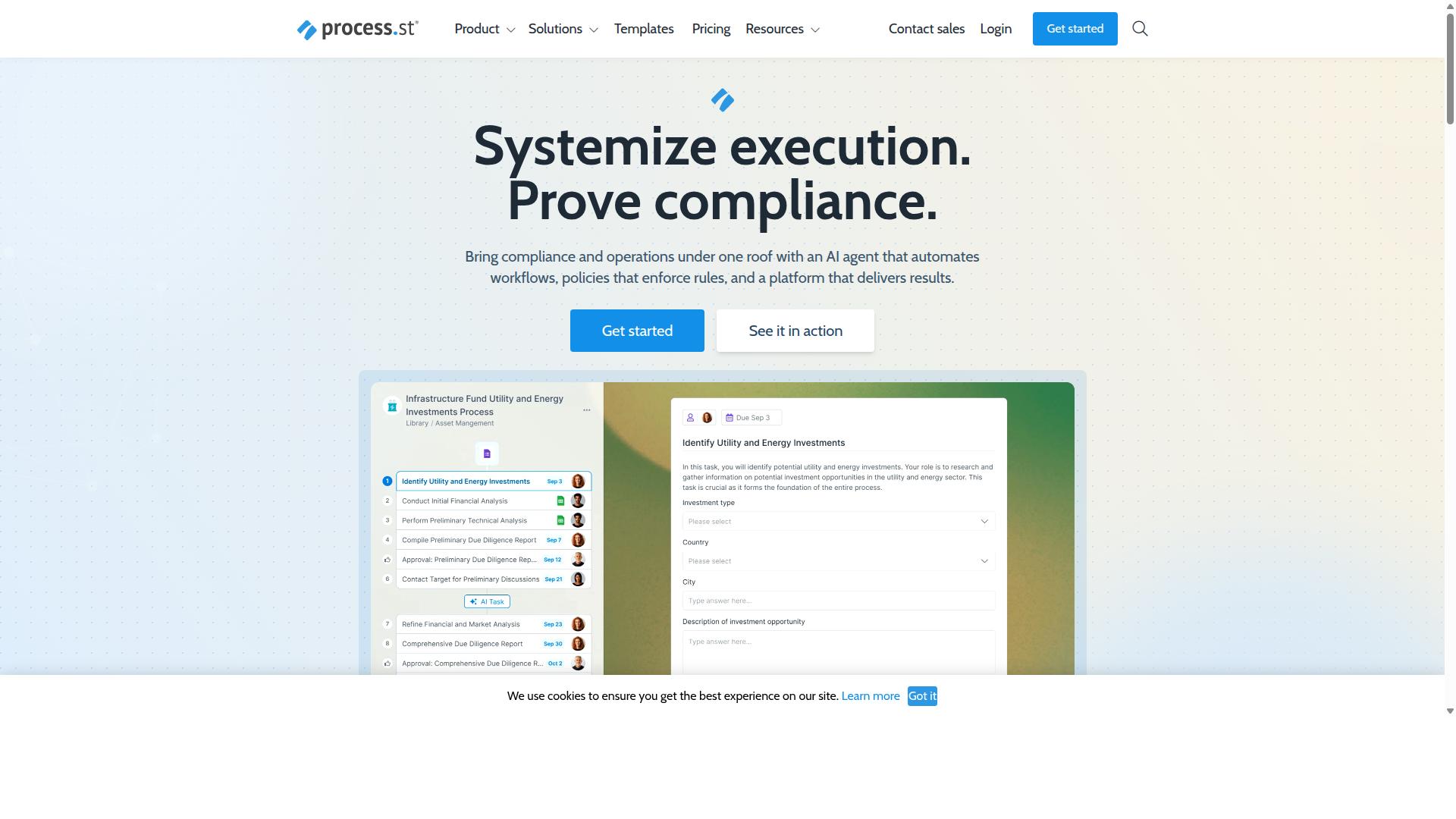
Process Street combines document governance with AI-driven workflow execution to deliver audit-ready outputs across regulated industries.
More than 3,000 organizations and 1 million users rely on the platform for governance risk compliance programs that maintain consistent control frameworks.
The platform holds SOC 2 Type II and ISO 27001 certifications, which demonstrate strong security practices and data protection controls.
IMCD UK reported 30 percent faster documentation cycles and 75 percent reduction in setup time after moving its compliance operations to the platform.
Process Street Ops for GRC Automation
Process Street Ops converts static GRC policies into AI-powered, conditional workflows that assign tasks and route approvals automatically.
Ops maps ISO 9001, SOC 2, SOX, and FDA clauses directly to workflow steps so every requirement remains visible during execution.
Each step records timestamps, assignee history, and linked evidence to create an immutable audit trail for regulators.
A quarterly access-review workflow can generate tasks across employees and route each task through the proper approval chain.
Process Street Cora AI Compliance Agent
Cora AI monitors live data feeds, flags control deviations, and drafts remediation tickets before auditors arrive.
The agent ingests evidence from connected systems, calculates risk scores, and surfaces only items above a user-defined threshold.
The platform can detect password-policy violations across separate SaaS applications and open remediation tickets automatically.
Process Street Pricing for Enterprise Teams
Process Street offers three tiers with published limits that scale from startup pilots to global enterprise deployments.
The Startup tier caps five users and 100 automation actions per month while providing up to 5,000 Data Set records and ten automation apps.
Pro and Enterprise tiers unlock unlimited users, custom Data Set records, custom automation apps, and premium data-residency options.
Enterprise customers contact sales for custom quotes that include dedicated success management and fully-managed workflows.
2. Diligent
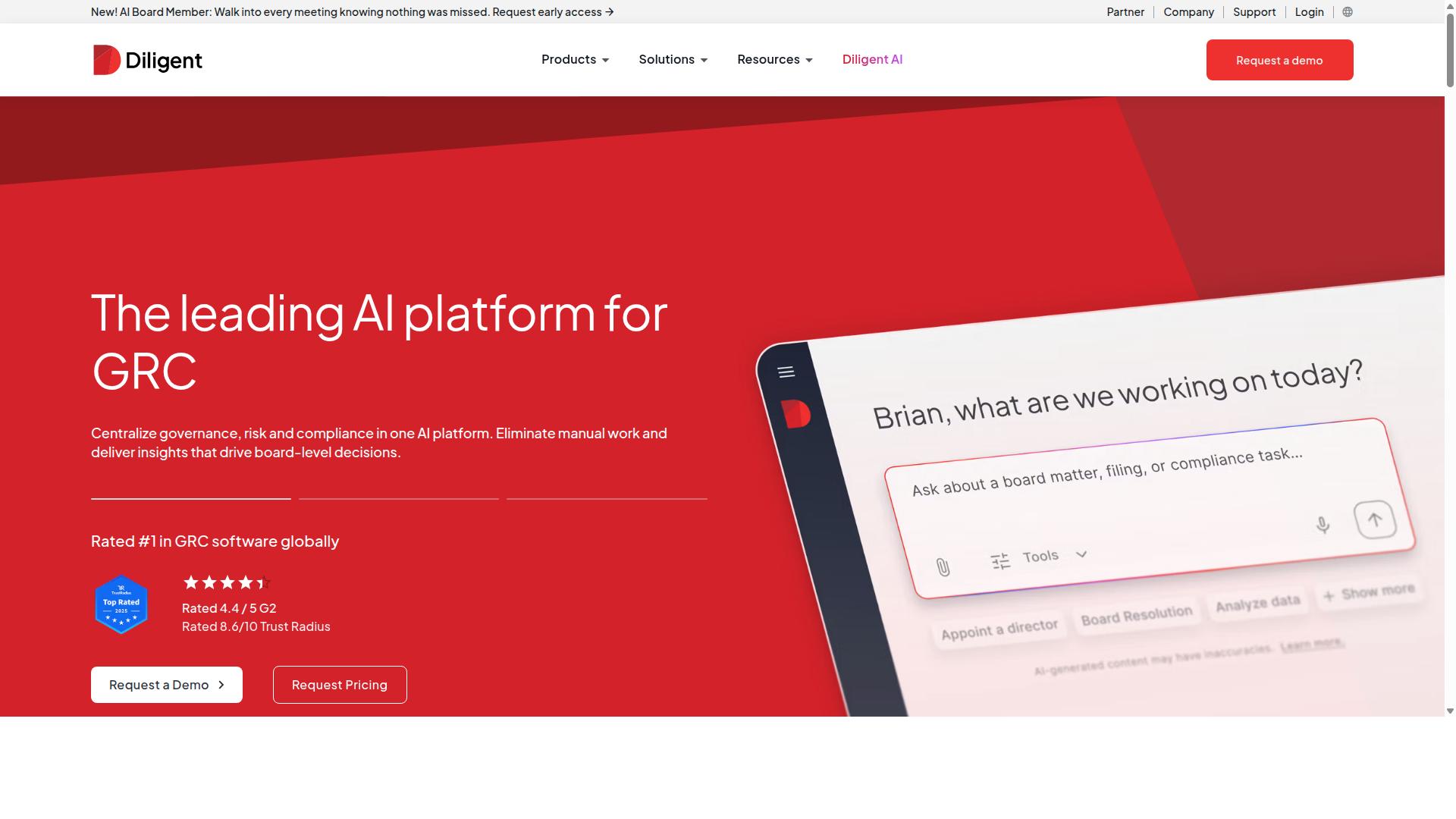
Diligent provides integrated GRC modules designed for board-level reporting and policy oversight.
The platform centralizes governance risk compliance activities across entities. Organizations use it to track subsidiary records and maintain board management functions.
Users access specialized tools for meeting preparation and data security needs. The system supports corporate secretaries and general counsel in handling complex reporting requirements.
Teams manage third-party relationships through dedicated risk modules. The platform helps compliance officers monitor vendor activities and track potential conflicts of interest.
Diligent GRC Workflow Capabilities
Diligent's workflow engine routes policy attestations and control-testing tasks to designated owners while maintaining immutable logs.
The policy portal guides policy drafting through structured stages. Stakeholders receive notifications during review cycles. Automated reminders keep processes moving forward without manual follow-up.
Evidence attachments connect directly to control records. Teams can add supporting documents during testing phases. The system preserves complete audit trails for regulatory compliance reviews.
The platform supports SOX and GDPR frameworks through standardized processes. Organizations apply these structures to their internal controls and data privacy programs. Risk heat-maps display assessment results across business areas.
Audit management features help internal auditors plan engagements. Teams schedule testing activities and track remediation items. Reporting dashboards provide visibility into compliance status at any time.
3. Onspring
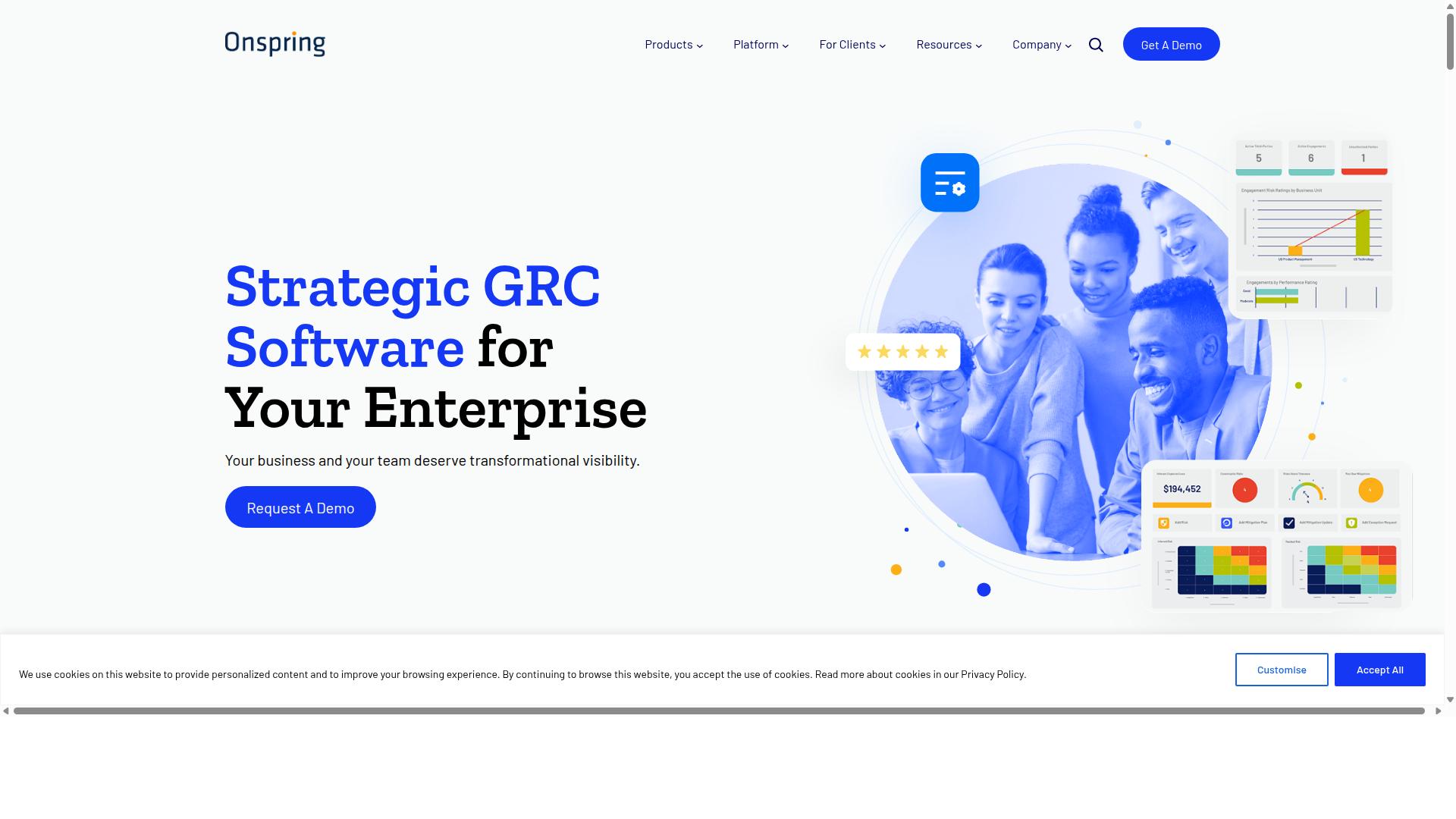
Onspring offers configurable GRC apps that centralize risk registers and compliance checklists.
Enterprise teams use these applications to maintain oversight across multiple regulations and internal policies. The platform supports structured data collection that feeds into larger governance frameworks.
Built-in workflow capabilities connect different parts of the compliance process. Teams can move information between risk assessments, control testing, and remediation tracking without manual handoffs.
Document management features keep supporting materials attached to specific risk records. This approach reduces the time spent searching for evidence during audits or assessments.
Onspring Workflow Automation Features
Onspring automates task assignments and escalations once a risk assessment or control test falls outside tolerance.
Due-date thresholds trigger notifications when items approach deadlines. Conditional approval steps route requests based on risk levels or organizational hierarchy.
Dashboard widgets display open items organized by owner or regulation. Teams can quickly identify who handles specific tasks and which regulations require attention.
These views support continuous monitoring by highlighting items that need review. Automated reminders keep processes moving without requiring constant manual oversight.
Issue management workflows connect identified problems to remediation plans. Stakeholders receive updates as items progress through resolution stages.
How to Choose the Right Option
Selecting the right GRC automation platform depends on team size, regulatory scope, and integration requirements.
Start by mapping your user and guest counts. Enterprise deployments often span Operations, Compliance, Finance, and IT teams, each needing distinct permissions and visibility levels.
Next, document the compliance frameworks you must support. Common requirements include SOX compliance, GDPR compliance, ISO 27001, and SOC 2.
Consider whether AI-assisted evidence collection will reduce manual work for your audit processes. This feature can accelerate document management and control testing across multiple frameworks.
Review data-residency constraints early. Some organizations require data to remain within specific geographic boundaries for regulatory or contractual reasons.
Finally, establish your budget range and compare pricing models across vendors. Operations teams typically prioritize task orchestration and automated workflows, while Compliance focuses on policy management and audit trail capabilities.
Finance departments often need strong internal controls, reporting dashboards, and KPI tracking features. IT and security teams require robust access management, security controls, and change management functionality.
Process Street serves teams across Operations, Compliance, Finance, and IT, supporting use cases such as employee onboarding, client onboarding, ISO compliance, quality tracking, and document control.
The platform addresses needs in financial services, real estate, manufacturing, healthcare, professional services, technology, capital markets, and property management.
Compare each option against your specific requirements rather than selecting based on general market positioning alone.
Final Verdict
Process Street stands out for organizations that require both document governance and AI-powered workflow execution with measurable efficiency gains.
Companies achieve 30% faster documentation and a 75% reduction in setup time compared to traditional approaches. These results support teams managing enterprise GRC requirements where speed and accuracy matter most.
The platform holds SOC 2 Type II and ISO 27001 certifications. It also meets HIPAA, GDPR, CCPA, and AWS CIS compliance standards. Data stays protected and never trains AI models.
More than 3,000 enterprise customers rely on the system for governance, risk, and compliance programs. Users report five-minute average response times and a 98% satisfaction rating.
Organizations handling complex approval processes, control testing, and continuous monitoring find the combination of certifications and performance metrics valuable for maintaining regulatory compliance.
Recommended Resources: