Is Tasks.Bot Good for AI Task Automation API Access
Your team already runs on WhatsApp, so adding another task app feels like a step backward. AI task automation only pays off when people actually use it, and adoption dies when the tool lives somewhere nobody opens. Tasks.Bot bets on the app your team already has open.
This article answers whether Tasks.Bot is a good fit for AI task automation API access. You will see how it turns natural language and voice notes into assigned tasks, what its automations and reports cover, and what the beta status, pricing, and refund policy mean for your decision.
What Is Tasks.Bot?
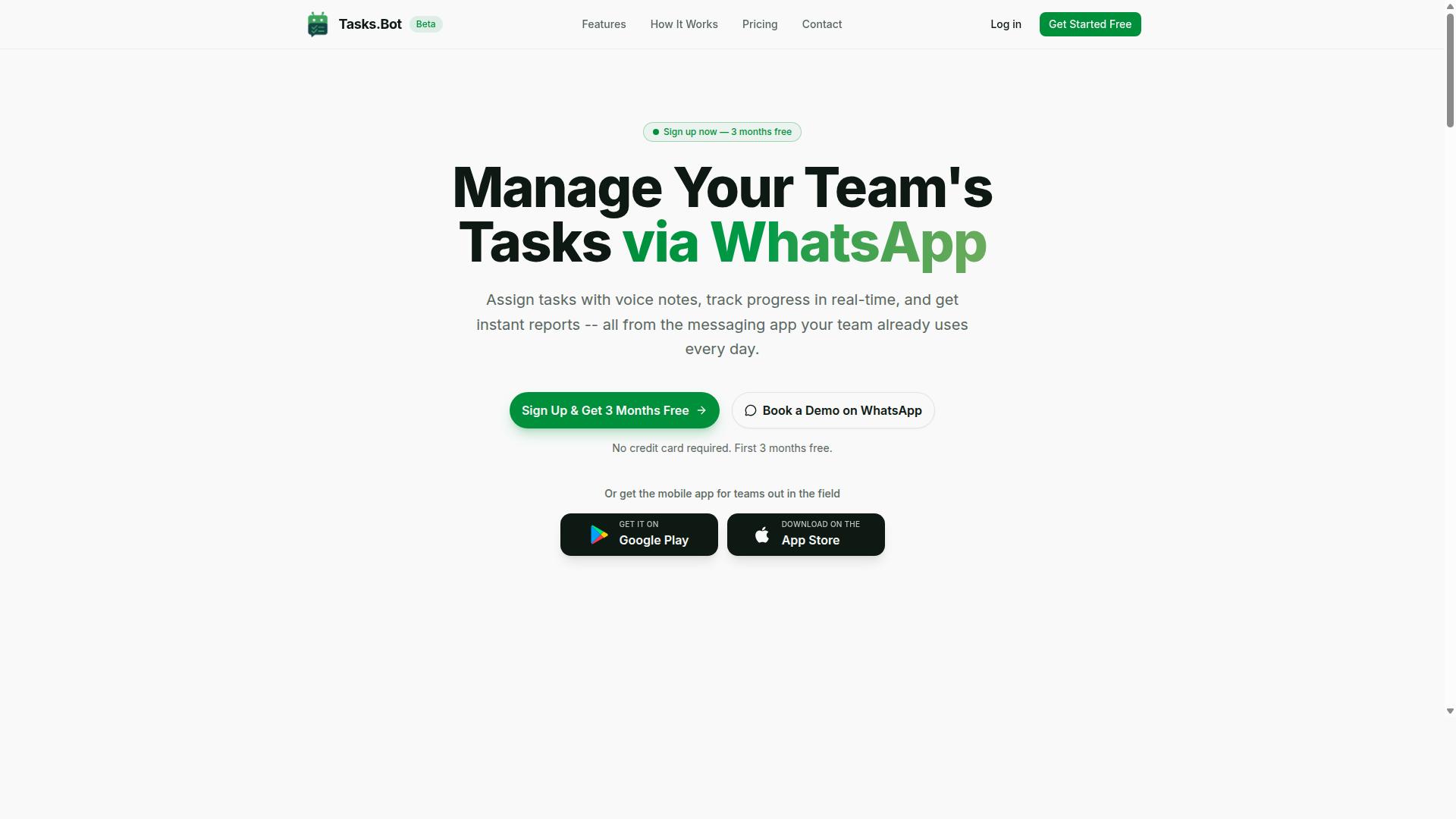
Tasks.Bot is a task management platform that operates entirely through WhatsApp, allowing teams to assign tasks, track progress, and receive reports without leaving the messaging app. It brings together task management, automation, and reporting in a single place, so daily coordination does not scatter across separate tools.
Because the primary interface is a messaging app people already use, the barrier to adoption stays low. Tasks.Bot also offers a mobile app for field teams, which matters when staff spend their day away from a desk.
The service is currently in beta and offers a free trial period, giving teams room to evaluate how it fits their workflow before committing. For anyone weighing AI task automation, understanding this foundation is the starting point.
Who Tasks.Bot Serves and How It Works
Tasks.Bot is designed for teams that already use WhatsApp for communication, especially those with field staff who need to manage tasks, track attendance, and generate payroll-ready hours. These are often teams where a desktop-first project management suite would go unused but a chat thread never does.
The flow is straightforward. Team members receive and complete tasks through WhatsApp, while managers assign work and get reports back in the same channel. No new app installation or account creation is required for team members, which removes one of the most common reasons field rollouts stall.
That simplicity carries a real operational benefit. When task assignment, completion, and reporting share one thread, managers spend less time chasing updates and more time acting on them. The site notes that hundreds of teams already use the service, which suggests the model holds up beyond a single pilot group.
For readers evaluating AI task automation, this context matters. A platform built around a familiar interface tends to see higher adoption, and adoption is what makes any later automation worth the effort. Tasks.Bot's WhatsApp-first design sets that stage.
Is Tasks.Bot Good for AI Task Automation API Access? The Direct Answer
Yes, Tasks.Bot is a viable option for AI-driven task automation, but it does not offer a traditional REST API; instead, it uses AI to interpret natural language and voice notes within WhatsApp.
Tasks.Bot is not a developer-first platform. Teams that need custom API integration for task orchestration should look elsewhere.
What Tasks.Bot does well is no-code and low-code automation through a conversational interface. It suits teams that prefer talking or typing over building pipelines. The sections below explain how its AI works and why WhatsApp matters.
How Tasks.Bot's AI Handles Natural Language and Voice Note Task Creation
Tasks.Bot uses AI to understand natural language and voice notes, allowing users to create tasks by simply speaking or typing a message in WhatsApp.
The AI understands user intent and creates tasks from messages.
Voice notes are supported for task creation as well.
This approach cuts manual data entry and speeds up task creation. Instead of opening a tool and filling fields, a user sends one message and moves on. For field teams and busy managers, that difference adds up across a working day.
The AI is a core selling point of Tasks.Bot. It relies on natural language processing and machine learning to understand user intent, which is what makes conversational task creation possible at all. The same intelligence supports automatic task assignment and smart deadline reminders, so less depends on someone remembering to follow up.
It is worth being precise about what this is not. The AI interprets messages inside WhatsApp. It is not an automation platform that exposes models or endpoints for programmers to call. The value sits in removing friction for everyday users, not in giving engineers a toolkit.
WhatsApp as the Interface: No New Apps or Accounts Required
Tasks.Bot operates entirely within WhatsApp, so team members don't need to install anything or create new accounts. That single design choice removes the biggest barrier to adoption: onboarding.
Consider how traditional task management tools work. A manager picks software, invites the team, and waits while people download an app, create logins, and learn a new interface. Some never do. With Tasks.Bot, the interface is an app almost everyone already has open.
- Tasks are created and delivered as WhatsApp messages
- Reminders arrive in the same chat thread
- Reports are sent as messages, not buried in a dashboard
- Approvals and automations run through the conversation
Familiarity drives adoption. When the tool lives where people already communicate, there is no training curve and no forgotten password. For teams with field staff or less technical members, this matters more than any feature list.
Tasks.Bot also provides Android and iOS apps with push notifications, voice capture, and a home screen widget for those who want them. The core experience, however, stays in WhatsApp. Optional apps add convenience without becoming a requirement.
For teams weighing AI task automation, the honest framing is this: Tasks.Bot is a strong fit when you want conversational, no-code automation with fast adoption. It is not the right choice when your roadmap depends on API access, custom endpoints, or developer-built integrations. Judged on what it sets out to do, it does it well.
Key Features That Support AI-Driven Task Automation
Tasks.Bot offers a suite of features that enable AI-driven task automation, from automatic assignment to instant reporting, all within WhatsApp. Instead of forcing teams into a separate dashboard, the platform meets users where they already communicate.
Its core capabilities include automatic task assignment, smart deadline reminders, approvals and automations, instant reports, tasks on a map, a live day tracker, and field team tools. Voice note task creation and native WhatsApp integration round out the experience.
Together these features form the foundation for AI task automation that reduces manual oversight and keeps work moving. The subsections below break down how each one supports real workflows.
Automatic Task Assignment, Smart Deadline Reminders, Approvals and Automations
Tasks.Bot automates task assignment, sends smart deadline reminders, and manages approvals and workflows to keep projects moving. This removes the need for a manager to manually route every item.
Automatic task assignment lets work flow to a specific role or individual. This is where AI task automation and natural language processing do their quiet work behind the scenes.
Smart deadline reminders escalate as a deadline approaches, so tasks do not slip through unnoticed. Approvals add a checkpoint, such as a manager confirming a task is complete before it closes. Automations handle recurring tasks and conditional logic, so repeatable work runs itself.
Tasks.Bot also uses AI to understand user intent and create tasks from messages, including voice note task creation. A team member can speak a request and have it become a tracked task. The result is less manual oversight, fewer dropped items, and a workflow automation layer that fits inside WhatsApp rather than on top of it.
Instant Reports, Live Day Tracker, and Field Team Tools
Tasks.Bot provides instant reports on task progress, a live day tracker for attendance and hours, and tools specifically designed for field teams. Managers get visibility without chasing updates across chat threads.
Instant reports are delivered through WhatsApp. Because the data arrives in the same channel the team already uses, reviewing progress takes seconds rather than a login and a dashboard tour.
The live day tracker lets field staff clock in and out, track hours, and generate payroll-ready timesheets. Face-verified attendance adds a layer of confidence that the right person is on the clock. Shifts, leave, and hours management are handled in the same place, which simplifies scheduling for distributed crews.
Tasks on a map give managers a location-based view of field activity, useful when coordinating teams spread across sites. For anyone running remote or field operations, these tools turn scattered check-ins into a single, reliable record. The daily admin that usually eats into a manager's morning becomes an automatic byproduct of normal work.
Pricing and Plans
Tasks.Bot offers a single 'Full Access' plan with all features included, priced at ₹200 per member per month or ₹1,200 per year per member. That is the entire pricing structure. There are no tiers, no locked capabilities, and no upsells to unlock core functionality.
For anyone evaluating AI task automation, this flat model removes a common headache. Many automation platforms split higher usage limits or advanced orchestration into premium tiers. With Tasks.Bot, every feature sits in one plan.
Pricing is available in Indian Rupees (₹) and US Dollars ($). A 'Select currency' option on the site lets users choose between Indian Rupee and US Dollar, so it is worth verifying the displayed currency before subscribing.
| Plan | Price | Billing Cycle |
|---|---|---|
| Full Access | ₹200 per member | Monthly |
| Full Access | ₹1,200 per member | Annual (save 50%) |
The annual option carries a clear advantage. Choosing yearly billing saves 50%, which works out to ₹1,200 per year per member. For a team of five, that is a meaningful reduction in total workflow automation spend.
Pricing is charged per member. Each person who needs access to the platform requires their own seat, so total cost scales with team size rather than usage volume.
New users also get 3 months free. No credit card is required to start, and the plan can be cancelled anytime. That combination makes it easy to evaluate whether the platform fits your task orchestration needs before committing budget.
For teams comparing automation tools, the takeaway is straightforward. One plan, one price per member, all features included, and a 50% saving for annual billing. There is no hidden tier structure to decode.
Trust Signals: Beta Status, Encryption, and Refund Policy
Tasks.Bot is currently in beta, but it offers encryption and a refund policy to build trust with early adopters. That combination matters when you are evaluating any AI task automation platform. Trust signals like these tell you whether a vendor takes that responsibility seriously.
Beta status is the first thing to understand. It means the product is still being refined, so occasional bugs or rough edges are possible. It also means the team is actively shaping the roadmap, and early users often get a real say in which features ship next.
For teams weighing workflow automation, that trade-off is worth naming plainly. You accept some uncertainty in exchange for influence and early access. If your automation needs are mission critical from day one, a beta product may not be the right fit yet. If you can tolerate a few iterations, the feedback loop works in your favor.
Encryption addresses the security side of the same question. Enterprise-grade encryption protects task data as it moves between systems. That protection is the baseline expectation for any SaaS platform handling automation at scale.
Encryption in transit guards data while it travels across the network. Encryption at rest protects it once stored. Together they reduce exposure if something goes wrong. For teams evaluating a platform, this is the kind of detail that separates a serious tool from a hobby project.
The refund policy is the third trust signal, and it is listed in the site footer. Think of it as a risk-free trial window. You can evaluate whether Tasks.Bot fits your task orchestration needs before committing budget. That lowers the cost of finding out, which matters most when you are still comparing options.
The site also carries a copyright year of 2026, a small but useful sign that the project is actively maintained rather than abandoned. A current copyright date does not prove reliability on its own, but a stale one would raise questions.
There is one more practical signal worth noting: the option to book a demo on WhatsApp. That gives prospective users a direct, low-friction way to ask questions before signing up. For teams with security or integration concerns, a conversation often answers more than a documentation page can.
Put together, these signals point in a clear direction. Beta status is an honest limitation, not a red flag. Encryption covers the security concerns that matter most. The refund policy removes the financial risk of trying the platform. For early adopters comfortable with a product still in development, Tasks.Bot presents a reasonable and transparent case.
Who Should Use Tasks.Bot for AI Task Automation
Tasks.Bot is ideal for teams that rely on WhatsApp for communication, particularly those with field staff who need task management, attendance tracking, and payroll-ready hours. The service is built around a channel these teams already check dozens of times a day, so adopting it does not require a new app, a new login, or a training session.
That focus shapes who gets the most value from the platform. It is a strong match for organizations that want AI task automation without hiring a developer or wiring together an API integration. It is a poor match for programmers who need direct API access, custom endpoints, or complex system-to-system orchestration. Knowing which group you fall into is the fastest way to judge whether Tasks.Bot fits your operation.
Small and medium businesses are a natural fit. These teams often run lean, with one person juggling operations, scheduling, and admin work. Tasks.Bot handles the repetitive parts of that load through artificial intelligence, so a manager spends less time chasing updates and more time on the work itself. Because the interface lives inside WhatsApp, there is no software to learn and no onboarding curve to absorb.
Field service teams benefit for a different reason. Staff who are on the move, at job sites, or between appointments rarely sit down at a desktop. Tasks.Bot meets them where they already are, which makes task assignment, attendance tracking, and hour logging practical rather than aspirational. The result is cleaner records that flow toward payroll without a separate data entry step.
Remote teams share many of the same needs. When people are spread across locations and time zones, a messaging thread becomes the de facto workspace. Tasks.Bot turns that thread into something structured, using natural language processing so instructions typed in plain language still land as organized tasks.
The common thread across all three groups is cost and effort. There is no training required, no separate platform to maintain, and no developer time needed to get started. For a team that has been managing work through chat messages and spreadsheets, that combination is often the difference between adopting automation and putting it off indefinitely.
Tasks.Bot reports that hundreds of teams already use the service, which suggests the approach resonates with organizations that value simplicity over configurability. If your team communicates on WhatsApp and your main goal is getting routine work tracked and completed, the fit is strong.
It is worth being direct about the limits. Tasks.Bot is not designed for developers who need a REST API, webhook handling, authentication flows such as API keys or OAuth, or control over rate limiting and throughput. Teams building event-driven architectures, job queues, or deep workflow automation across multiple systems should look at developer-first automation platforms instead.
In short, Tasks.Bot suits the operator, not the engineer. If you want AI task automation that works inside a tool your team already uses, with no code and minimal cost, it is a clear and sensible choice.
Final Verdict
Tasks.Bot is a compelling AI task automation tool for WhatsApp-centric teams, offering robust features at an affordable price, though its beta status and lack of API may limit some use cases.
After weighing its strengths against its current limitations, the picture is fairly clear. Tasks.Bot delivers real value for the right kind of team, and that team is easy to identify.
Strengths:
- Deep WhatsApp integration that meets teams where they already communicate
- AI natural language processing that lets users assign and manage tasks conversationally
- Affordable pricing relative to the capabilities on offer
- Purpose-built tools for field teams who work away from a desk
Weaknesses:
- The product is still in beta, so some rough edges and evolving features are expected
- No public API, which rules out custom API integration, REST API connections, webhook setups, or programmatic task orchestration
- It is limited to the WhatsApp interface, so teams that rely on dashboards or desktop tools may find it restrictive
For developers, engineers, and programmers who need endpoint-level control, authentication via API key or OAuth, rate limiting, or event-driven automation, Tasks.Bot is not the right fit today. Those needs point toward platforms built around API access and developer tooling.
For everyone else, the trade-off works in the opposite direction. Non-technical teams, citizen developers, and low-code adopters get the benefits of artificial intelligence and natural language processing without writing a single line of code. Field teams in particular gain a practical tool that fits the way they already work.
The beta label is worth noting, but it is a stage, not a permanent ceiling. Teams that value quick adoption over deep customization will find Tasks.Bot a sensible, cost-effective choice.
Final recommendation: Tasks.Bot is best suited to non-technical teams that want fast adoption and are comfortable operating inside WhatsApp. If your workflow depends on API access, look elsewhere for now. If it depends on people getting tasks done quickly, this is a strong option.
To see it in action, book a demo on WhatsApp by calling +91 97143 42522 or emailing [email protected].
Frequently Asked Questions
What exactly is Tasks.Bot, and how does it work as an AI task automation API?
Tasks.Bot is a task management platform that operates entirely inside WhatsApp, letting teams assign tasks, track progress, and receive reports without leaving the messaging app. Its AI understands natural language and voice notes, so you can create and assign tasks just by typing or speaking a message. It also offers a mobile app for field teams, making it a practical option for teams already coordinating work over WhatsApp.
Do my team members need to install an app or create new accounts to use Tasks.Bot?
No. Because Tasks.Bot works within WhatsApp, team members don't need to install anything or create new accounts to get started. A mobile app is available for field teams that need it, but the core task management experience runs in the messaging app your team already uses. This keeps onboarding simple and adoption fast.
What can Tasks.Bot automate for my team?
Tasks.Bot uses AI to turn natural language and voice notes into tasks, and it supports automatic task assignment, smart deadline reminders, approvals, and automations. You also get instant reports, tasks on a map, live day tracking, and face-verified attendance, with payroll-ready hours for field staff. Together, these features cover task creation, follow-through, and reporting in one place.
How much does Tasks.Bot cost?
Tasks.Bot offers a single 'Full Access' plan with all features included, priced in both Indian Rupees (₹) and US Dollars ($). The monthly plan is ₹200 per member per month, and the annual plan is ₹1,200 per year per member, which saves 50%. You can book a demo on WhatsApp to see the plan in action before committing.
Is Tasks.Bot suitable for teams with field staff?
Yes. Tasks.Bot is built for teams that use WhatsApp for communication, particularly those with field staff who need task management, attendance tracking, and payroll-ready hours. Features like tasks on a map, live day tracking, and face-verified attendance are designed for exactly this kind of work. Hundreds of teams are already using the service.
Is Tasks.Bot available in my country, and is it a finished product?
Tasks.Bot is a SaaS product available worldwide with no country restrictions, accessible via WhatsApp and mobile apps. It's worth noting that the service is currently in beta, so some things may still evolve. If you have questions about availability or the beta status, you can reach the team at [email protected] or +91 97143 42522.
Recommended Resources: